← All topics

Recovery

The long view, pacing, trends, milestones and turning months of data into decisions that bend your recovery the right way.

Kinga Howard / Unsplash
Austin Spaeth August 19, 2026 HRV

Cortisol and HRV: How Your Stress Hormones Shape Heart Rate Variability

Cortisol is the slow, long-acting arm of your stress response, and it tends to move opposite to vagal HRV: when cortisol is high, beat-to-beat variability (RMSSD, HF power) usually runs low. That is why HRV is naturally lowest in the first hour after waking, when the cortisol awakening response peaks. Cortisol does not appear in an HRV reading directly, so use HRV as a same-time-of-day trend and read the two together, not as a cortisol test.

Read the full story
Unsplash POTS

Aug 12, 2026 · Austin Spaeth

Weather and POTS: How Barometric Pressure, Humidity, and Cold Shift Your Symptoms

Many people with POTS and dysautonomia swear their symptoms track the weather, and the physiology backs up a lot of it. Here is what barometric pressure, humidity, cold snaps, and passing fronts actually do to an autonomic nervous system, and how to tell whether the sky is really your trigger.

Read article →
Andrej Lišakov / Unsplash Recovery

Aug 11, 2026 · Austin Spaeth

Clean Days and Protocol Streaks: Tracking What You Control

A clean day is one that met the protocol you set for yourself. Autonomic counts your current streak and the share of the last 30 days that stayed clean. Here is why compliance is the right thing to measure in autonomic recovery, how to set a protocol you can actually hit, and why a broken streak is data rather than failure.

Read article →
Briana Tozour / Unsplash Recovery

Aug 11, 2026 · Austin Spaeth

Heart Rate Zones Explained: Z1 to Z5, and How to Read Them With Dysautonomia

Heart rate zones split effort into five bands off your estimated maximum heart rate. Here is what each zone actually does physiologically, why the age formula is only an estimate, and how to read time-in-zone when you have POTS, long COVID or post-exertional malaise.

Read article →
Jp Valery / Unsplash Basics

Aug 11, 2026 · Austin Spaeth

Overnight Heart Rate: What Your Sleeping Low and High Reveal

Your overnight low is the cleanest resting heart rate you will ever get: no posture, no caffeine, no white-coat effect. Here is when in the night it happens, what the overnight high reflects, and why a rising low is one of the earliest warnings you have.

Read article →
bruce mars / Unsplash HRV

Aug 11, 2026 · Austin Spaeth

Sleep Apnea and HRV: Why It Keeps Your Nervous System on Edge

Undiagnosed sleep apnea is one of the most common hidden reasons HRV stays stuck low and morning heart rate runs high. Here is the physiology, how it shows up in your own overnight and morning numbers, and why the POTS and long COVID crowd gets missed.

Read article →
kike vega / Unsplash POTS

Aug 9, 2026 · Austin Spaeth

POTS vs Deconditioning: How to Tell the Difference

"You're just deconditioned" is one of the most common things people with POTS hear. Both can race your heart when you stand, but they behave differently over time. Here is how to read the difference at home without talking yourself out of care.

Read article →
Brooke Lark / Unsplash Food

Aug 7, 2026 · Austin Spaeth

Magnesium, HRV and POTS: Does It Actually Help, and How to Tell

Magnesium is one of the most recommended supplements in POTS and long COVID circles, usually for sleep, palpitations and calmer nerves. The evidence for a direct HRV boost is modest, but the indirect route through better sleep is real. Here is the honest picture, the forms that actually differ, the blood-pressure caution POTS makes important, and how to test whether it helps you.

Read article →
Anna Pelzer / Unsplash POTS

Aug 6, 2026 · Austin Spaeth

Iron Deficiency and POTS: Why Ferritin Matters When Your Labs Look Normal

Low iron stores are common in POTS and can quietly amplify tachycardia, fatigue and lightheadedness, often while a standard blood count still reads normal. Here is how ferritin fits in, why the lab range can miss it, and what to track at home.

Read article →
Unsplash POTS

Aug 5, 2026 · Austin Spaeth

Compression Garments for POTS: What Actually Works and How to Wear Them

Compression is one of the few non-drug tools with real evidence behind it for POTS. The catch: where you compress matters far more than most people realize. Here is what the research shows and how to use it.

Read article →
Jp Valery / Unsplash HRV

Jul 30, 2026 · Austin Spaeth

Why Does HRV Drop When You're Getting Sick? Reading the Early Warning

A day or two before the sore throat or the fatigue, your heart rate variability often dips and your resting heart rate creeps up. Here is why an infection pulls HRV down, how to tell an illness dip from an ordinary bad night, and how to use the signal to rest instead of push.

Read article →
Unsplash POTS

Jul 29, 2026 · Austin Spaeth

Blood Pooling in POTS: Why Blood Collects in Your Legs When You Stand (and What Helps)

When you stand, gravity pulls a large volume of blood down into your legs and belly. In POTS that pooling is exaggerated and slow to correct, so your heart races to compensate. Here is the physiology in plain terms, why your feet can turn dusky, and the practical moves that push blood back where it belongs.

Read article →
Kinga Howard / Unsplash POTS

Jul 28, 2026 · Austin Spaeth

Why Are POTS Symptoms Worse in the Morning? The Overnight Physiology and a Gentler Start

If your POTS symptoms are at their worst in the first hour after waking, there are real, well-understood reasons. Here is what happens to your blood volume, hormones and heart rate overnight, and a calmer, step-by-step way to get out of bed.

Read article →
The Ridge Ohio / Unsplash Long COVID

Jul 27, 2026 · Austin Spaeth

Long COVID Brain Fog: The Autonomic Connection (and How to Track the Pattern)

Long COVID brain fog is not just fatigue in disguise. A large part of it tracks with your autonomic nervous system, especially how your body handles being upright. Here is the physiology in plain language, and how to find your own pattern.

Read article →
Jared Rice / Unsplash HRV

Jul 26, 2026 · Austin Spaeth

How to Stimulate the Vagus Nerve: What Actually Works (and What's Overhyped)

The vagus nerve is the main line of your parasympathetic 'rest and digest' system, and its activity shows up directly in your HRV. Here is what genuinely raises vagal tone, what is plausible but oversold, and how to tell which is which using your own numbers.

Read article →
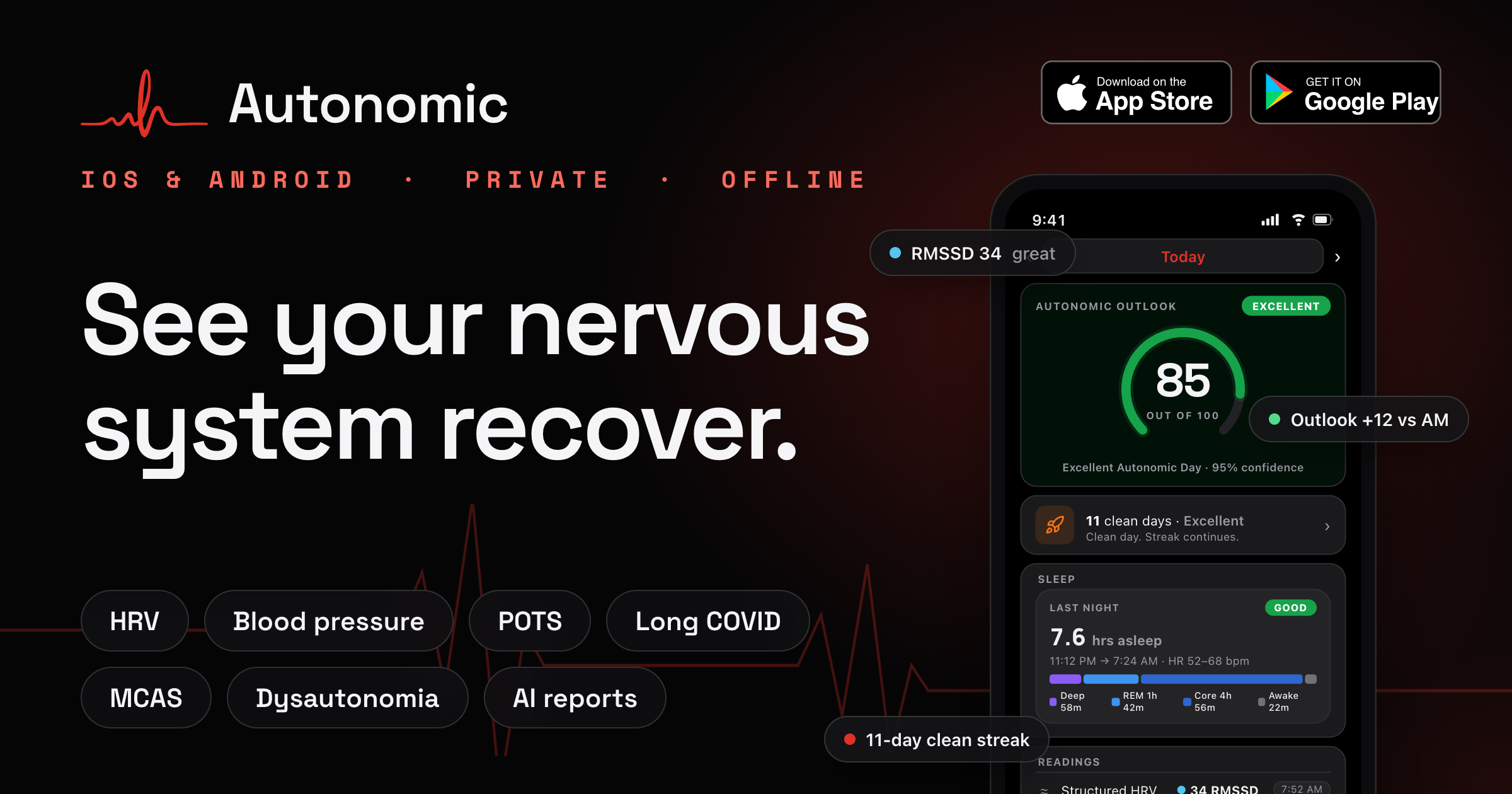
See Your Nervous System Recover The app

Jul 23, 2026 · Austin Spaeth

See Your Nervous System Recover

Dysautonomia is invisible, and that's half of what makes it so hard: you can't see the illness, and you can't see the recovery either. Autonomic is the app that makes recovery visible: HRV, blood pressure, stand tests and sleep, scored, trended, and kept private on your phone.

Read article →
Sage Friedman / Unsplash POTS

Jul 22, 2026 · Austin Spaeth

Adrenaline Dumps in POTS: Why Your Heart Races (and Why It Usually Isn't a Panic Attack)

That sudden racing heart, tremor and wave of dread, often at 3am or after standing, has a name patients use: an adrenaline dump. Here is the physiology behind catecholamine surges in POTS, how to tell them apart from panic attacks, and how to track and settle them.

Read article →
Giorgio Trovato / Unsplash POTS

Jul 21, 2026 · Austin Spaeth

Heat Intolerance and POTS: Why Hot Weather Wrecks Your Numbers (and How to Track It)

Heat is one of the most reliable triggers in POTS and dysautonomia. Here is the physiology behind why hot weather raises your heart rate, drops your HRV, and worsens standing symptoms, plus the practical cooling and tracking moves that actually help.

Read article →
HRV: The Complete Guide to Reading Your Nervous System HRV

Jul 9, 2026 · Austin Spaeth

HRV: The Complete Guide to Reading Your Nervous System

Heart rate variability is the single clearest at-home window into your autonomic nervous system. This is the complete guide: what RMSSD, SDNN, HF and LF actually mean, what moves them, how to measure well, and how to read the trend without spiraling.

Read article →
Recovery from Post-Viral Dysautonomia: Turning Data Into Decisions Recovery

Jul 7, 2026 · Austin Spaeth

Recovery from Post-Viral Dysautonomia: Turning Data Into Decisions

Recovery from POTS and post-viral dysautonomia is slow, noisy and non-linear, which is exactly why it's so easy to lose hope in the day-to-day. Here's how to pace, read your trends, and turn months of scattered data into decisions that actually bend the curve.

Read article →
Kevin Wang / Unsplash Food

Jul 6, 2026 · Austin Spaeth

Gentle Low-Histamine Meal Ideas for Bad POTS Days

A crash-day toolkit of low-effort, lower-histamine meals that also respect POTS: salt-forward, easy to digest, and cookable with minimal standing. Idea lists, not fussy recipes, with one habit that changes everything: cook fresh, freeze fast.

Read article →
Andrej Lišakov / Unsplash The app

Jul 5, 2026 · Austin Spaeth

Getting Started with Autonomic: Your First Week of Tracking

A friendly, low-effort plan for your first seven days. Set a baseline, build a simple morning habit, and learn what to ignore while your data is still finding its feet.

Read article →

Jul 3, 2026 · Austin Spaeth

Autonomic: Measure, Analyze, Monitor, Act

Everything about autonomic recovery comes down to one loop: measure what's happening, analyze the trend, monitor for warnings, and act. Autonomic is the app built to close that loop: private, offline, and scored against medical thresholds.

Read article →
Ronaldo de Oliveira / Unsplash Recovery

Jul 1, 2026 · Austin Spaeth

What Recovery Actually Looks Like: The Non-Linear Curve

Recovery from post-viral dysautonomia and POTS is real but slow, and it almost never moves in a straight line. Here is what the honest timeline looks like, why plateaus mislead you, and what to watch instead of the daily noise.

Read article →
Sage Friedman / Unsplash HRV

Jun 25, 2026 · Austin Spaeth

Resonant Breathing & HRV Biofeedback: The 6-Breaths-a-Minute Protocol

Slowing your breath to about six breaths a minute is one of the few things that reliably raises HRV in real time. Here is the mechanism, a concrete protocol, and honest caveats for sensitive nervous systems.

Read article →
Jp Valery / Unsplash Recovery

Jun 20, 2026 · Austin Spaeth

Sleep and Autonomic Recovery: Your Biggest Daily Lever

Most of your parasympathetic restoration happens overnight, which makes sleep the single biggest lever you have on autonomic recovery. Here is how dysautonomia disrupts it, and gentle, realistic ways to sleep better.

Read article →
Sasha Freemind / Unsplash HRV

Jun 18, 2026 · Austin Spaeth

How to Improve Your HRV: What Actually Works (and What Doesn't)

The honest, evidence-based guide to raising heart rate variability, ranked by real-world impact. Sleep and pacing beat any gadget, and in post-viral illness HRV mostly rises as the underlying dysregulation heals.

Read article →
Rajasekhar R / Unsplash POTS

Jun 11, 2026 · Austin Spaeth

POTS Treatment: Salt, Fluids, Compression & Medication Explained

POTS treatment usually starts with volume, compression and a careful exercise ramp, and adds medication when those aren't enough. Here's how each piece works and why it's almost always a combination.

Read article →
Jordan Bauer / Unsplash Recovery

Jun 6, 2026 · Austin Spaeth

Pacing 101: How to Find and Expand Your Energy Envelope

Pacing is the single most important recovery skill for POTS, long COVID and ME/CFS. Here is how to find the edge of your energy envelope, stop the boom-and-bust cycle, and expand your capacity without triggering a crash.

Read article →
Ahya Agawis / Unsplash HRV

Jun 4, 2026 · Austin Spaeth

Why Your HRV Dropped Overnight: Reading the Daily Number

You checked your morning HRV and it cratered. Before you spiral, here is what actually moves a single reading, why one day is mostly noise, and how to read the rolling trend that really matters.

Read article →
Alehandra / Unsplash Recovery

May 26, 2026 · Austin Spaeth

How to Find Your Triggers With a Symptom Journal

Scattered logs rarely reveal what sets off a crash. Here is how to keep a symptom journal that turns daily notes into cause-and-effect, including the delayed reactions that make triggers so hard to spot.

Read article →
Briana Tozour / Unsplash POTS

May 23, 2026 · Austin Spaeth

Exercise for POTS: The Levine Protocol & How to Start Safely

Upright exercise often backfires early in POTS. The recumbent-first approach (the Levine and CHOP protocols) trains your heart lying down first, then works toward standing over months. Here is how to start without crashing.

Read article →
Romain Water / Unsplash Recovery

May 21, 2026 · Austin Spaeth

Why You Feel Better at Night With MCAS (and Why Late Nights Still Cost You)

That window between 10pm and 1am where the symptoms lift and you finally feel like yourself is real physiology, not avoidance. Here is what actually produces it, why the relief is borrowed rather than earned, and how to keep the good part without paying for it three days later.

Read article →
Kinga Howard / Unsplash Long COVID

May 19, 2026 · Austin Spaeth

Post-Exertional Malaise: What Long COVID Recovery Depends On

Post-exertional malaise is the delayed, disproportionate crash after exertion that defines ME/CFS and shadows long COVID. Here is why the delay makes it dangerous, why pushing through backfires, and how to see it coming.

Read article →
Turn Months of Data Into a Five-Minute Doctor Conversation Recovery

May 14, 2026 · Austin Spaeth

Turn Months of Data Into a Five-Minute Doctor Conversation

Appointments are short and symptoms are hard to describe from memory. Here is how to use your own tracked data to walk in with a clear, specific summary your clinician can act on.

Read article →

Browse all 35 articles in Recovery →

Track your recovery with Autonomic

A private, offline journal that scores your daily HRV, BP and orthostatic readings against medical thresholds. Free to download on iPhone and Android, with $7.99/mo Pro when you want the deep-analysis tools.

Download free