





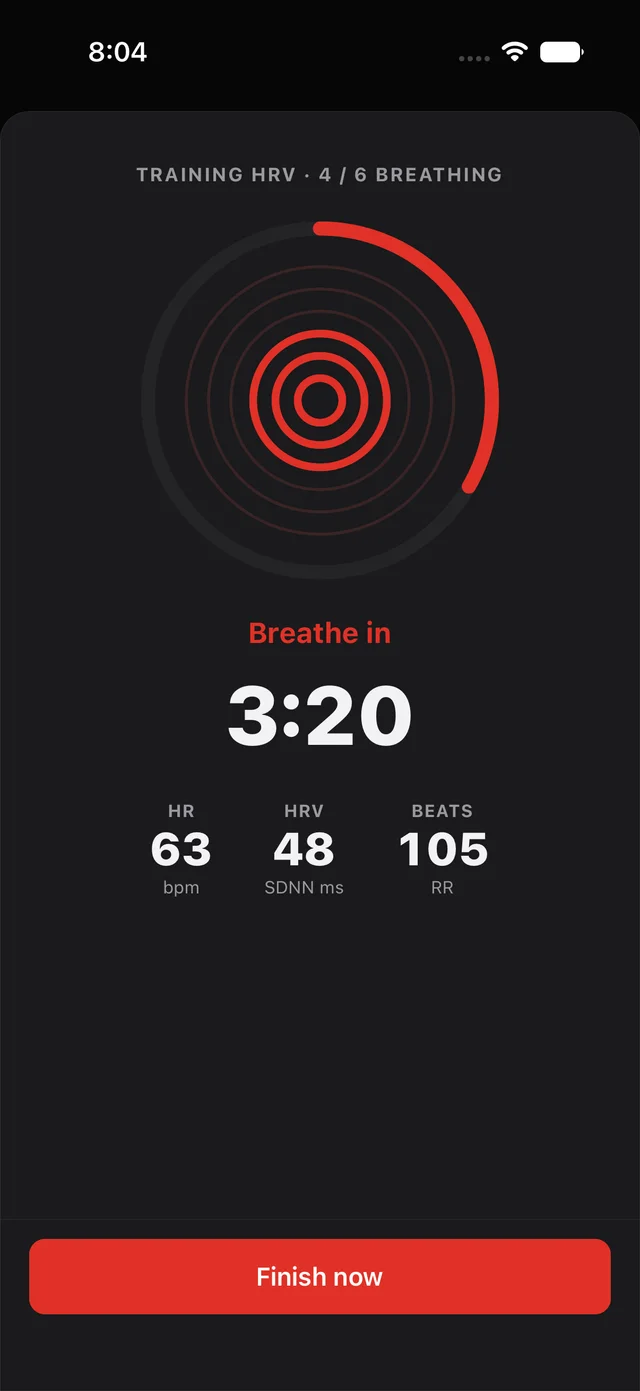
Five minutes each morning shows how your nervous system recovered overnight, against your own normal.
Helps with every condition here
Free to download
On iPhone and Android, with 14 days of Pro to start. No card needed.




4.9 App StoreNo account · Your data stays on your phone

Pick what sounds like you. Each one opens a short, plain-language guide.
Three tools, and the conditions each one helps most. Start free with one morning reading.
Five minutes each morning shows how your nervous system recovered overnight, against your own normal.
How much today can take, in hours and minutes, so you stop before the crash rather than after it.
What lines up with your better days: the supplement, the salt, the early night, or nothing at all.
All three sit on one journal for symptoms, meds and triggers, and turn into a summary for your doctor. With POTS, a guided stand test measures what standing does to you.
I’ve been through a dozen apps trying to manage my POTS and PEM. I can say without a doubt Autonomic is the BEST one I’ve tried.
These often travel with POTS, long COVID and ME/CFS. Log their symptoms in the same journal, and Insights reads them all together. Each opens a guide.
| Condition | What defines it | Worth tracking | In Autonomic | Read first |
|---|---|---|---|---|
| POTS | Your heart rate jumps 30 beats or more within ten minutes of standing, and stays up. | Standing heart rate rise, morning HRV, salt and fluids | POTS stand test | How POTS is diagnosed |
| Long COVID | Symptoms that last months after a COVID infection, often with POTS-like heart rate swings or crashes after effort. | Morning HRV, resting heart rate, effort and crashes | Pacing budget | Is it long COVID or POTS? |
| ME/CFS | A crash that lands a day or two after doing too much, called post-exertional malaise. | Daily effort, the two days after, sleep and symptoms | Pacing budget | Post-exertional malaise, explained |
| Dysautonomia | The nervous system that runs heart rate, blood pressure, digestion and temperature stops keeping its balance. | Morning HRV, resting heart rate, blood pressure, sleep | Journal + HRV | The autonomic nervous system, explained |
| Chronic illness | Good days and bad days with no obvious reason, and a long list of things you are trying. | What you take and do, triggers, symptoms, sleep | Insights | Find your triggers with a journal |
POTS, long COVID, ME/CFS, mast cell activation syndrome (MCAS) and other forms of dysautonomia overlap far more than chance would suggest. Many people meet the criteria for more than one, and many arrived the same way: an infection, often a virus, after which the body’s automatic controls never quite settled back1.
Each has its own defining feature. POTS is a heart rate that races when you stand2,4. ME/CFS centers on post-exertional malaise, the delayed crash after doing too much3. Long COVID can look like either, or both. What they share is a nervous system struggling to keep its balance, which is why the same few signals, HRV, heart rate and what standing does to you, say so much about all of them. Autonomic is built around those signals, and reads each one against your own normal, so it works whether you carry one diagnosis or several.
“I’ve been through a dozen apps trying to manage my POTS and PEM. I can say without a doubt Autonomic is the BEST one I’ve tried.”
“It’s already helping me manage my health and gather data to show providers.”
“Only app that isn’t for athlete training and specific to dysautonomia.”
Dysautonomia is the umbrella term for any problem with the autonomic nervous system, the part that runs heart rate, blood pressure, digestion and temperature without you thinking about it. POTS is one form of it, defined by a heart rate rise of at least 30 beats per minute within ten minutes of standing (40 for ages 12 to 19), without a large drop in blood pressure, with symptoms for at least three months.
Yes. POTS and other forms of dysautonomia are among the most commonly reported problems after COVID-19. Many people with long COVID notice a racing heart on standing for the first time after their infection, which is why a stand test is worth doing if that sounds familiar.
No, but they overlap. ME/CFS can follow many different infections and was described long before COVID. Its defining feature is post-exertional malaise, a delayed crash after effort. A substantial share of people with long COVID meet the criteria for ME/CFS, and pacing matters for both.
Usually a cardiologist or a neurologist, ideally one with an autonomic specialty, and often alongside your primary care doctor. Many long COVID clinics also see dysautonomia. A record of your stand tests and symptoms helps whoever you see.
With a symptom history and an active stand test or a tilt table test, and by ruling out other causes such as dehydration, anemia, thyroid problems and medications. A home stand test cannot diagnose POTS, but it can show your clinician what standing does to you over weeks.
No. Plenty of people start tracking while they wait for answers, and a careful record of your readings and symptoms can make that first appointment far more useful. Autonomic does not diagnose anything; it keeps the record.
No, and it is common. Every number in Autonomic is read against your own history rather than a population average, so it works the same whether you carry one diagnosis or four, and Insights looks across everything you log.
No. It is a personal tracking tool. It organizes your data and points out patterns, and it never tells you to start, stop or change a treatment. Always work with your clinician.
The journal is free forever, with no account and no ads, including unlimited HRV readings and your daily score. Autonomic Pro is $7.99 a month or $49.99 a year, and every install starts with 14 days of Pro, with no card.
Free on iPhone and Android, with 14 days of Pro. No card, no account.