

Journal + HRV: Track your HRV in five minutes, on any device.
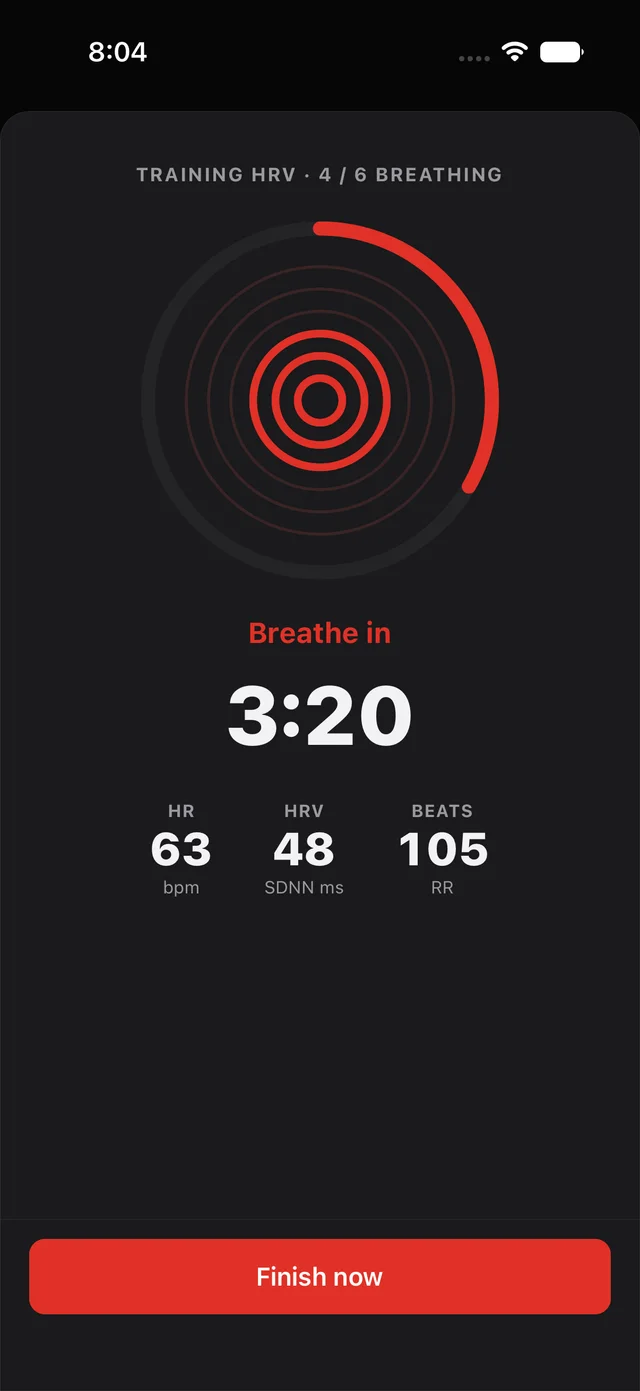
One still reading a morning is what the whole app runs on. Take it with your phone camera, a watch or a strap, log the rest of your day around it, and see every number graded against your own normal rather than a chart built for athletes.



Unlimited HRV capture is free, forever
“I’ve been through a dozen apps trying to manage my POTS and PEM. I can say without a doubt Autonomic is the BEST one I’ve tried.”
“It’s already helping me manage my health and gather data to show providers.”
“Only app that isn’t for athlete training and specific to dysautonomia.”
The questions one morning reading answers.
Tap a question to jump to how Autonomic answers it.
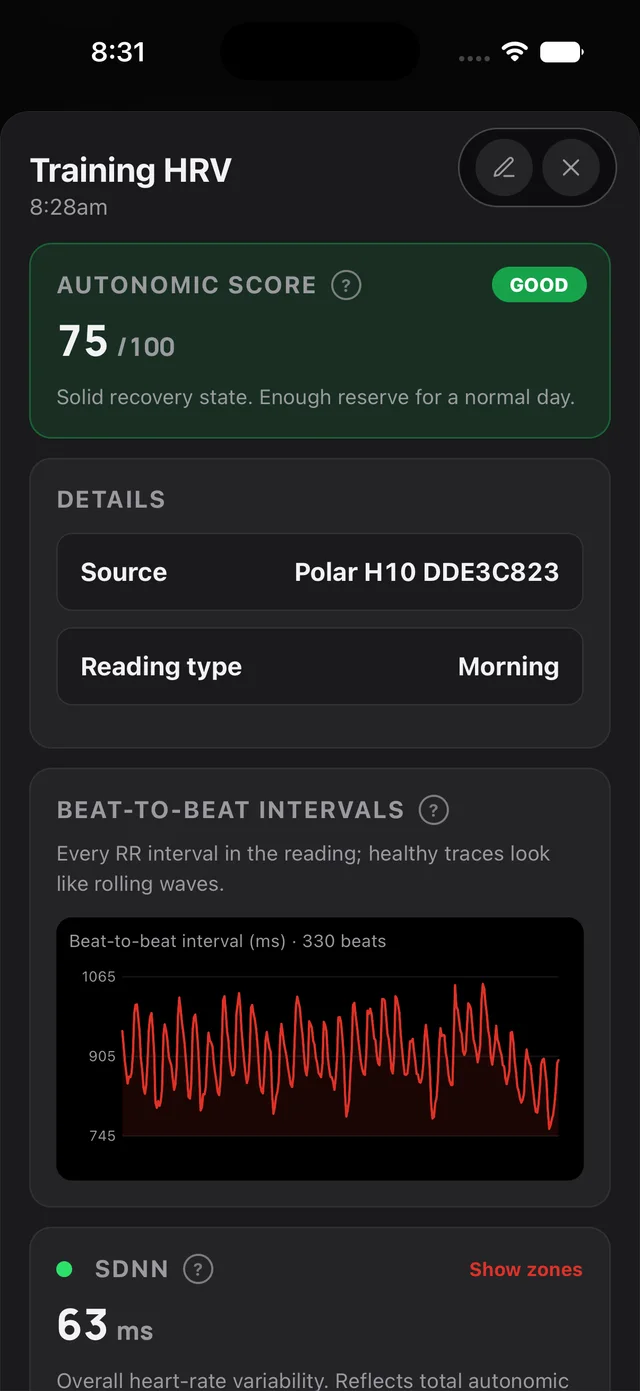
Is today a good day? One score out of 100.
Graded from Excellent to Crash, with a sentence that says what kind of day your body can handle. It is waiting for you before you stand up.
- 1Baseline HRV leadsThe day’s first still reading carries the most weight of anything in the score.
- 2Sleep, resting heart rate and blood pressureLast night and this morning, each graded against medical thresholds.
- 3Training can lift it, a littleA paced breathing session can raise the day by one grade at most, so practice never hides a hard morning.
Symptoms, meals and digestion never move the score, so logging honestly never costs you points.
Four ways to take the same HRV reading.
No new gadget required. If you own better hardware, the app will use it, and every reading lands in the same journal.
 Better Apple WatchTake the reading from your wrist with the companion app, and it lands in your journal when it finishes. Needs an iPhone.
 Better Garmin watchThe Autonomic app for Garmin records every beat and sends them to your phone, on iPhone or Android.

 Best Chest strap or bandBeat-to-beat intervals over Bluetooth, the cleanest signal there is. Polar H10 and Coospo straps work, and so do Polar optical bands like the Verity Sense.
Already measuring somewhere else? On iPhone, HRV from Apple Health comes in too, when it carries at least four minutes of real beat-to-beat data. Health Connect has no beat-to-beat data, so on Android readings are taken in the app. Which chest strap to buy
Not just a number. What the number means.
RMSSD, SDNN, pNN50 and the frequency bands, each scored and coloured against medical thresholds, with the raw beat-to-beat trace underneath so you can see it for yourself.
- ABaselineFive minutes breathing normally, first thing. The one that sets your day.
- BTrainingFive minutes of paced breathing, when it feels good. A gentle workout for your autonomic system, and the reading that shows its spectral bands.
- CYour own normalOnce you have a few mornings, each grade is also checked against your own usual. That check can only lower a grade, so a long bad stretch never starts reading as fine.
What HRV is, and why it matters with dysautonomia.
- When
- Right after waking
- Position
- Lying still
- Length
- Five minutes
- Read it against
- Your own trend
Heart rate variability (HRV) is the tiny variation in time between one heartbeat and the next. A healthy heart is not a metronome: it speeds up a little as you breathe in and slows as you breathe out, steered by the autonomic nervous system1. More of that variation usually means a more flexible, better-regulated system. Less of it usually means the system is stuck leaning toward “fight or flight.”
That is why HRV matters so much with dysautonomia, POTS and long COVID. When the autonomic nervous system is the thing that is struggling, HRV is one of the few windows onto it you can open at home, every day, for free2. It often falls before a harder stretch and climbs, slowly, as recovery takes hold.
RMSSD, SDNN and the rest
The number worth watching day to day is RMSSD, the short-term, beat-to-beat signal of your rest-and-digest side. SDNN is broader, closer to your overall capacity3. Autonomic computes both, plus pNN50, heart rate, and the frequency bands that paced breathing brings out, and grades each one so you are not left decoding milliseconds on your own.
Why your own normal beats any chart
There is no universal “good HRV.” It falls with age4, differs between healthy people several-fold5, and depends heavily on how it was measured6, which is why the charts online so rarely help. HRV by age explains the ranges, and why the spread inside any age band is wider than the gap between them. What matters is your reading against your own recent mornings, measured the same way each time, and the direction it travels over weeks7.
Why first thing in the morning
The morning reading captures how well you recovered overnight, under the one set of conditions you can repeat every day: lying still, before coffee, before the day has happened to you. That repeatability is what makes Tuesday comparable with Friday. Why the morning reading wins goes deeper.
Why it took a dedicated app
Fitness trackers grade HRV for athletes chasing a training load. Autonomic was built for people whose question is whether they can get through the day, so the thresholds, the warnings and the advice are written for recovery, not performance. And every reading stays on your phone.
Sources
Checked November 2026- Heart rate variability: standards of measurement, physiological interpretation, and clinical use Task Force of the European Society of Cardiology and the North American Society of Pacing and Electrophysiology. Circulation 93(5):1043–1065, 1996. The founding standard for measuring HRV and what it reflects.
- Long COVID: major findings, mechanisms and recommendations Davis HE, McCorkell L, Vogel JM, Topol EJ. Nature Reviews Microbiology 21(3):133–146, 2023. Dysautonomia and POTS as common features of long COVID.
- An overview of heart rate variability metrics and norms Shaffer F, Ginsberg JP. Frontiers in Public Health 5:258, 2017. What RMSSD, SDNN and pNN50 each measure.
- Twenty-four hour time domain heart rate variability and heart rate: relations to age and gender over nine decades Umetani K, Singer DH, McCraty R, Atkinson M. Journal of the American College of Cardiology 31(3):593–601, 1998. HRV falls with age.
- A quantitative systematic review of normal values for short-term heart rate variability in healthy adults Nunan D, Sandercock GRH, Brodie DA. Pacing and Clinical Electrophysiology 33(11):1407–1417, 2010. How widely “normal” HRV varies between healthy people.
- Comparison of heart-rate-variability recording with smartphone photoplethysmography, Polar H7 chest strap, and electrocardiography Plews DJ, Scott B, Altini M, Wood M, Kilding AE, Laursen PB. International Journal of Sports Physiology and Performance 12(10):1324–1328, 2017. A phone camera reading against a chest strap and an ECG.
- Training adaptation and heart rate variability in elite endurance athletes: opening the door to effective monitoring Plews DJ, Laursen PB, Stanley J, Kilding AE, Buchheit M. Sports Medicine 43(9):773–781, 2013. Why HRV is read as a trend against your own baseline, not one morning.
Everything else that moves your numbers.
Log the rest of your day in taps, not paragraphs: symptoms, meds, water, triggers, activities and more, each with the time it happened. Much of it arrives from Apple Health or Health Connect on its own, so the days you have no energy to log still count.
| Log | What it can tell you | How it gets in |
|---|---|---|
| Sleep | Short or broken nights show up in the next morning’s reading. The sleep report adds stages and your overnight heart rate dip. | From Apple Health or Health Connect on its own, or bed and wake typed in |
| Symptoms | Dizziness, brain fog, palpitations, post-exertional malaise, blood pooling and dozens more, with when each one hit. | Built-in symptoms in two taps, plus any you create |
| Triggers | Heat, caffeine, alcohol, histamine-heavy foods, large meals, stress and prolonged standing. | A trigger list built for dysautonomia, tapped in as they happen |
| Meds and supplements | What you take, how much and when, so every start and stop has a date the app can test against. | Built-in or your own, with amount and time |
| Water and meals | Hydration is one of the biggest levers with POTS, and the easiest to forget by the afternoon. | A glass at a tap toward a daily goal, meals in a couple more |
| Digestion | Bowel movements by form, from hard to loose, and the gaps between them. | Graded by Bristol type, so a pattern is easy to see |
| Cycle | Where you are in your cycle, so a premenstrual dip is read against your past cycles. | Flow in a couple of taps, or brought in from Health |
| Blood pressure and resting heart rate | Both graded against medical thresholds, with the position you took them in. | Typed in from any cuff, or taken from your morning reading |
| Activities and rest | Walks, workouts, errands, hot showers and legs up, with their heart rate. | Logged in a tap, or workouts imported with their full heart rate trace |
| Clean days | The daily routine you are working on, and how often you actually keep it. | A checklist you set, which builds a streak |
FREE
Am I about to crash? An early flag, from your own numbers.
Two checks run on your journal every day. When either has something to say, the Journal says it in one plain sentence and shows you what moved.
- When your score slidesIf your daily score has been trending down for several days, you see it with the points and the days, and you can get a notification the morning a slide starts.
- Before the score movesResting and overnight heart rate, your standing rise, recovery after a workout and your symptom load are each compared with your own last six weeks. Two have to drift together before it speaks.
- Never one wobbly numberA single noisy reading never raises it. It stays quiet on an Excellent day, and when your cycle explains a dip, it says that instead.
An early flag, not a prediction. It can be wrong, and it never replaces how you feel.
I’ve been through a dozen apps trying to manage my POTS and PEM. I can say without a doubt Autonomic is the BEST one I’ve tried.
Weeks of readings, one honest HRV trend.
Day, week, month and year, or any range you pick, split by baseline and training, with grade zones you can switch on. It is the view that shows slow change you would never feel day to day.
The last 14 days are free. Week, month, year and your full history are part of Pro, and every install starts with 14 days of it.
How to build and use an HRV baseline →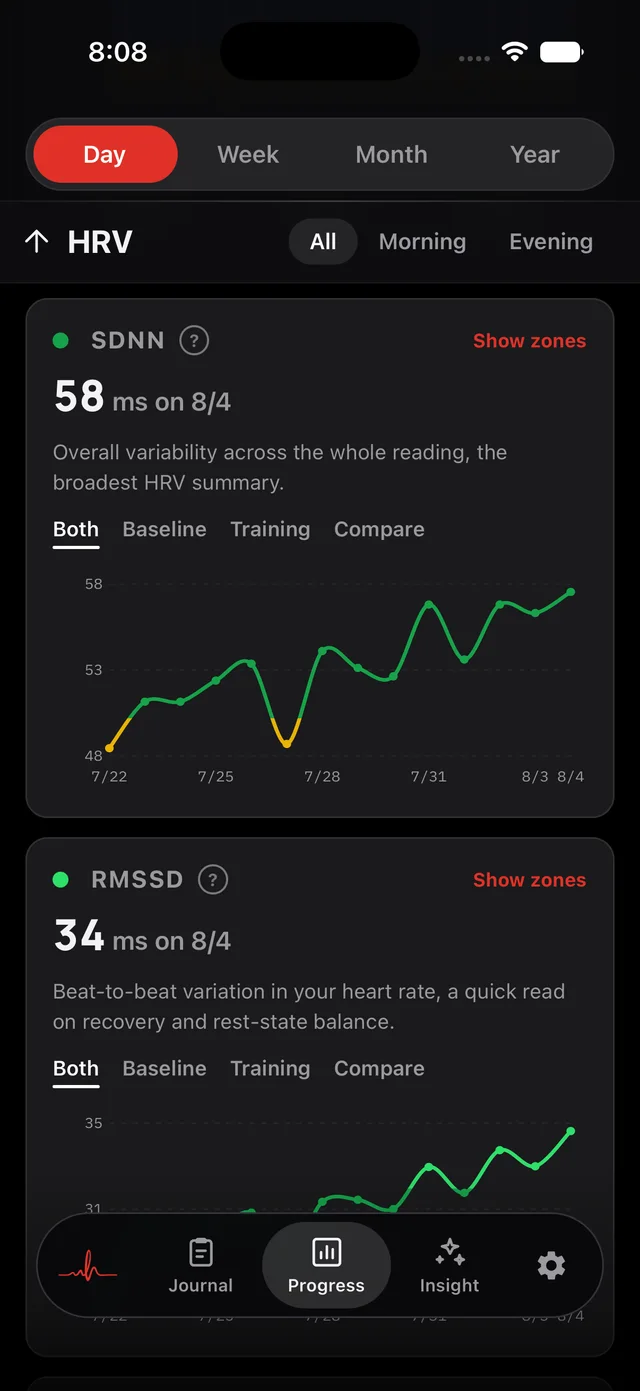
HRV questions, answered
How long does an HRV reading take?+
Five minutes. Lie still and breathe normally, ideally right after you wake and before you get up. Your first reading of the day sets your daily score and your pacing budget.
Do I need a wearable to measure HRV?+
No. Your phone camera can take the reading with a fingertip resting lightly on the lens. An Apple Watch, a Garmin watch or a Bluetooth chest strap gives a cleaner signal if you already own one.
Is HRV capture free?+
Yes. Live HRV readings are unlimited on every device and every plan, with no daily cap. Pro is what the app makes of your readings over time: the long views, Insights, the pacing budget and AI reports.
What is a good HRV?+
There is no single good number. HRV falls with age, differs between people several-fold, and depends on how it was measured. Autonomic grades each reading against medical thresholds and against your own recent normal, and the trend over weeks says more than any one morning.
What is the difference between a baseline and a training reading?+
A baseline is five minutes breathing normally, first thing, and it is the heaviest single input to your daily score. A training reading is five minutes of paced breathing. It can lift your day by at most one grade above its baseline, and never hides a bad morning.
What happens if a reading comes out noisy?+
The app grades its own signal. A reading with too much noise is never silently saved. If it is usable but rough, you are asked once, with the artifact rate in view. If it cannot be used, the app says why and what to try next, starting with the most likely cause.
Does Autonomic import HRV from Apple Health or Health Connect?+
From Apple Health, yes, when the reading carries at least four minutes of real beat-to-beat data. Short background samples from a watch are kept out of your averages, because they are not comparable with a still five-minute reading. Health Connect on Android stores no beat-to-beat data, so on Android HRV is not imported: take your readings in the app instead.
About HRV
All HRV articles →Take your first reading tomorrow morning.
Free on iPhone and Android. Your phone camera is enough.