

Answers for life with chronic illness. Stop relying on memory to know what helps.
Autonomic is a private symptom tracker for iPhone and Android, built for days that swing. Log symptoms, triggers, meds and supplements in a couple of taps, take a quick morning reading, and let your own data show what lines up with your better days.


Every install starts with 14 days of Pro, free
“I’ve been through a dozen apps trying to manage my POTS and PEM. I can say without a doubt Autonomic is the BEST one I’ve tried.”
“It’s already helping me manage my health and gather data to show providers.”
“Only app that isn’t for athlete training and specific to dysautonomia.”
The questions chronic illness leaves you with, answered.
Each one is a part of the app. Tap a question to see how it works.
Why memory is the wrong tool for a chronic illness.
- Compared against
- Your own days
- Corrected for
- Chance and the calendar
- Early hints from
- About 14 days
- What it claims
- Linked, never caused
A chronic illness is lived in weeks and months, but it is remembered in fragments. The worst day stands out, the slow improvements blur, and by the time you are sitting in an appointment it is hard to say whether the new supplement helped, whether flares are coming closer together, or whether last month was really worse than the one before. Brain fog makes all of it harder.
Chronic conditions also travel together. POTS, long COVID, ME/CFS, mast cell activation syndrome (MCAS) and hypermobile Ehlers-Danlos syndrome overlap far more than chance would suggest1, and plenty of people live with more than one. That makes “what is helping?” harder still: more symptoms, more triggers, more treatments to keep straight. Why POTS, long COVID and MCAS travel together explains the overlap.
What a good symptom journal does for you
- Captures the day while it is happening, in taps rather than paragraphs, so the bad days get logged too.
- Keeps everything on one timeline: symptoms, triggers, food, water, meds, supplements, sleep and a morning reading, so every flare has context2.
- Respects the delay. Plenty of triggers land a day or two later, which is why Insights also looks for links with the next day.
- Does the comparing without fooling you, with statistics that shrug off one odd reading, a correction for testing many things at once3, and a check that a link holds up within its own month rather than riding a good or bad season.
When nothing helps, that is an answer too
Autonomic tells you when a medication or supplement you have logged for weeks shows no detected impact on anything it could test. That is not proof it does nothing, but it is worth knowing, and worth raising with your clinician. It also says so when a change cannot be pinned on any one thing, because you started two things in the same week.
Sources
Checked November 2026- Long COVID: major findings, mechanisms and recommendations Davis HE, McCorkell L, Vogel JM, Topol EJ. Nature Reviews Microbiology 21(3):133–146, 2023. Dysautonomia and POTS as common features of long COVID.
- The n-of-1 clinical trial: the ultimate strategy for individualizing medicine? Lillie EO, Patay B, Diamant J, Issell B, Topol EJ, Schork NJ. Personalized Medicine 8(2):161–173, 2011. Studying one person against themselves, over many days.
- Controlling the false discovery rate: a practical and powerful approach to multiple testing Benjamini Y, Hochberg Y. Journal of the Royal Statistical Society, Series B 57(1):289–300, 1995. The correction Insights uses so patterns found by luck are not reported.
What to track with a chronic illness, and why.
Everything that might be moving your days, on one timeline, with as little effort as possible on the hard ones.
| Signal | What it can tell you | How Autonomic gets it |
|---|---|---|
| Symptoms | Fatigue, pain, brain fog, nausea, dizziness, flushing, palpitations and more, and when each one hit. | Built-in symptoms in two taps, plus any you create yourself |
| Flares | How often they come, how long they last, and what came before them. | Read off your journal and your daily score, with an early flag when things slide |
| Triggers | Heat, stress, overexertion, alcohol, histamine-rich foods, fragrances and more. | A built-in trigger list, from aged cheese to prolonged standing, plus your own |
| Meals and water | Large meals, particular foods and hydration often sit right behind a bad afternoon. | Meals and food triggers in taps, water by the glass |
| Medications and supplements | What you take, how much and when, and the day you started or stopped each one. | Logged with amount and time, and Insights reads the start and stop dates |
| Morning reading (HRV) | An objective signal under the symptoms: how much reserve your nervous system woke up with. | Five minutes with your phone camera, Apple Watch, Garmin or a chest strap |
| Sleep | The biggest daily lever for most people, and often the first thing to slip in a flare. | From Apple Health or Health Connect, or typed in |
| Digestion | Gut symptoms move with many chronic conditions, especially MCAS and dysautonomia. | Bowel movements logged by form and graded |
| Your cycle | Many symptoms gather before a period. Without the cycle, a predictable dip looks like a setback. | Flow in a couple of taps, or from Apple Health or Health Connect |
| Your routine | Whether you are keeping the daily protocol you are working on, and whether it holds up. | A clean-day checklist that builds a streak |
It tells you what changed, and what did not.
Beyond a ranked list of what lines up with your better days, Insights reads your journal the way you would if you had the time.
- 1Biggest changeWhat moved most since you started or stopped something, with everything else that changed in the same stretch named beside it.
- 2No detected impactThe meds and supplements you have logged for weeks that show no link to anything it could test.
- 3Best and hardest weeksYour best weeks set beside your hardest, with what was different between them. A description, never a verdict.
- 4Trend watchYour key numbers, this month against last, in plain words.
Stick with a routine, and see if it holds.
Set the daily protocol you are working on, from water and electrolytes to a morning reading or legs up after lunch. Each day that meets it builds a streak, and Progress shows how often you keep it, so a routine you are trying gets a fair test.
Read about clean days → I’ve been through a dozen apps trying to manage my POTS and PEM. I can say without a doubt Autonomic is the BEST one I’ve tried.
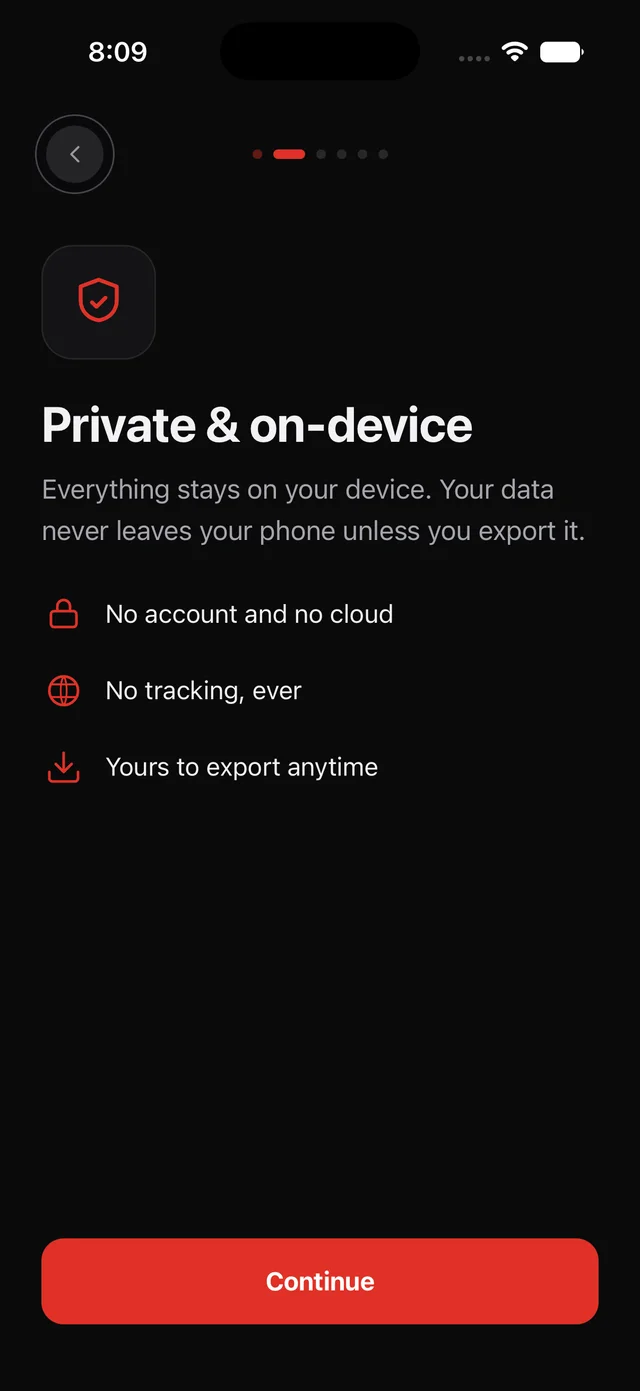
Your health is nobody’s business model.
No account to make, no cloud of ours to send it to, no ads and no tracking. Your journal, and every score and insight drawn from it, is worked out on your phone, and it is yours to export whenever you like.
Why we built it offline-first → vs
Comparing symptom trackers?
Bearable is a well-loved symptom diary. Autonomic keeps the diary and adds measurement and pacing.
Read the full comparison with Bearable → Syncs steps, sleep and heart rate from Apple Health and FitbitNo energy budget or live alertsCorrelations, with full reports on premiumOn your phone, and with an account also on its servers, encrypted

“I saw specialist after specialist, and kept leaving with no real answers. So I started tracking it myself. Autonomic is the tool I built to make sense of it.”
Austin Spaeth · more than four years with long COVID · dad of six, South Carolina
Read my story →Chronic illness questions, answered
What is the best app for tracking chronic illness symptoms?+
Log as it happens, in taps rather than paragraphs, so the bad days get recorded too. Keep symptoms, triggers, food, water, medications, supplements and sleep on one timeline, add an objective signal like a morning HRV reading, and let something compare the days for you. Autonomic does all of that in one private journal.
How long before Insights finds anything?+
Early hints can appear at around two weeks of logging, and stronger findings need more days. Insights is strict on purpose: it would rather show you nothing than something false, and an empty report is a real answer.
Can I track symptoms the app does not list?+
Yes. You can create your own symptoms, triggers, activities, medications and supplements, and they work everywhere the built-in ones do, including Insights.
Who can see my health data?+
Only you. There is no account, and your journal, scores and insights are all worked out on your phone. Nothing is sold or shared, and you can export everything whenever you like. If you choose to make an AI report, you copy it into the assistant yourself, and you can read every word first.
Can I share my journal with my doctor?+
Yes. With Pro, Autonomic builds a doctor summary from your readings, symptoms and medications, written by the AI you choose. You can also open any chart in the app and show it in the room.
Is Autonomic free?+
The journal is free forever, with no account and no ads, including unlimited HRV readings and your daily score. Autonomic Pro is $7.99 a month or $49.99 a year and adds Insights, the pacing budget, your full history and AI reports. Every install starts with 14 days of Pro, with no card.
Does it work on Android?+
Yes, on both iPhone and Android, at the same price. On Android, sleep and workouts come in from Health Connect, and HRV readings run with your phone camera or a Bluetooth chest strap. The Apple Watch app needs an iPhone.
About finding what helps
All recovery articles →The latest guides



Let your own data say what helps.
Free on iPhone and Android. No account, and your journal stays on your phone.