

POTS stand test: Measure your heart rate rise at home.
Why does your heart race when you stand up? Stop guessing. A guided test on your Apple Watch or chest strap puts a repeatable number on it, so you can follow it for months and bring it to your clinician.



Every install starts with 14 days of Pro, free
“I’ve been through a dozen apps trying to manage my POTS and PEM. I can say without a doubt Autonomic is the BEST one I’ve tried.”
“It’s already helping me manage my health and gather data to show providers.”
“Only app that isn’t for athlete training and specific to dysautonomia.”
The questions a stand test answers.
Tap a question to jump to how Autonomic answers it.
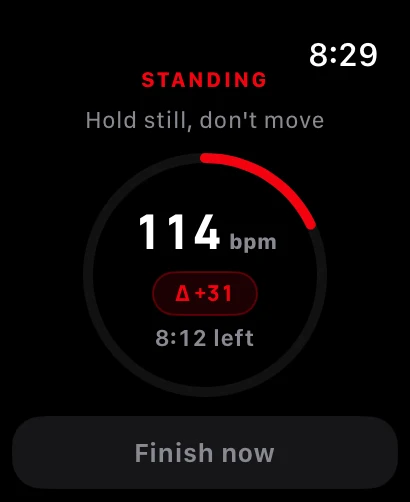
Fifteen minutes, guided the whole way.
The same active stand test many clinics run, done the same way every time, so this week’s result can be held up against last month’s.
 Apple WatchGuided by taps on your wrist, so you never touch your phone or watch a clock. Needs an iPhone.

 Chest strapA Polar H10, a Coospo or any Bluetooth heart rate strap, run in the app on iPhone or Android.
Or type in a test you did by hand, from any heart rate monitor.
Every number your clinician will ask for.
Your resting rate, your standing peak, the largest rise and the rise that held, with your rise at each minute and the full heart rate curve underneath.
Sample result. Reading your results is part of Pro; the test itself is saved on every plan.
One test is a snapshot. Eight are a direction.
Repeat it weekly under the same conditions and Progress lines every result up on one chart, so you and your clinician can see which way it is heading, even while you are still over the line.
- 1Directly comparableThe same protocol every time, so this week and last month are measured the same way.
- 2Sustained and peakBoth rises across every test, with how many met the POTS threshold.
- 3Said in plain words“Sustained rise improved 13 bpm across 8 tests in this range.”
Sample journal. Week, month and year views are part of Pro.
Catch an episode as it happens.
Symptoms rarely wait for a test. Tap once on the stairs or as you get up, and your heart rate is captured before the move, right after it, and one minute later, so you can see how far it jumped and how fast it came back.
On Apple Watch, or in the app with a chest strap. Heart rate only, never a diagnosis.
I’ve been through a dozen apps trying to manage my POTS and PEM. I can say without a doubt Autonomic is the BEST one I’ve tried.
How to read a stand test, number by number.
What each part of the result can tell you, and where Autonomic shows it.
| Number | What it can tell you | Where you see it |
|---|---|---|
| Resting rate | Your starting line. The rise is measured from here, so a rushed rest makes every number after it look bigger. | The five minutes lying still, timed for you |
| Peak rise | The largest jump above your resting rate at any moment on your feet. A single spike, on its own, says less than it looks. | Shown on the result, beside the curve it came from |
| Sustained rise | The rise that holds rather than spikes. A sustained rise of 30 bpm or more (40 in teens) is the line clinicians look for. | Checked against that line and flagged on the result |
| Minute by minute | Whether your heart settles, keeps climbing or stays high across the ten minutes. | The full heart rate curve, with your rise at each minute |
| Blood pressure | A drop of 20 systolic or 10 diastolic within three minutes points to orthostatic hypotension rather than POTS. | The test reads heart rate; log a cuff reading beside it |
| Your trend | One test is a snapshot. The same test repeated over weeks shows which way you are heading. | Every result kept, and read by cycle phase if you track one |
What a stand test is, and what it is not.
- Lying
- 5 minutes
- Standing
- 10 minutes
- POTS line
- 30+ bpm (40+ in teens)
- Repeat
- Weekly, same conditions
A stand test, sometimes called an active stand test or orthostatic test, measures what happens to your heart rate when you go from lying down to standing still. For most people the heart speeds up by a few beats and settles. In POTS, blood pools low in the body and the heart races to make up for it, so the rise is bigger and it holds1.
Clinicians look for a sustained rise of at least 30 beats per minute within ten minutes of standing (40 in teenagers), without a large drop in blood pressure, alongside symptoms that have lasted at least three months2,3. That is why the test runs for a full ten minutes: a spike in the first seconds is common, and what matters is the rise that stays.
Stand test or tilt table?
A tilt table test straps you to a table that tips you upright to around 60 to 70 degrees while blood pressure is tracked beat by beat. Because the table holds you still, it takes away the leg-muscle pumping that can mask symptoms. An active stand is simpler4, and it is the one you can repeat at home, every week, the same way. They are complementary: a home record can help you and your clinician decide what to test next.
How to get a clean result
- Same time, same conditions. Test at roughly the same time of day, for example before caffeine or breakfast, so each result can be compared with the last.
- Really rest first. The five minutes lying down are half the measurement. Talking, scrolling or getting up early all inflate the rise.
- Stand still. No walking, leaning or shifting. Walking is exercise, and exercise raises heart rate on its own.
- Note how you felt. Log dizziness, palpitations or the urge to sit alongside the result. The number and the symptoms belong together.
What a home test can and cannot tell you
It can put a repeatable number on what standing does to you, show whether that number is moving, and give your clinician a record from your real life instead of one afternoon in a clinic. It cannot diagnose POTS, rule other causes out, or tell POTS from orthostatic hypotension on its own, because that takes blood pressure too3.
Sources
Checked November 2026- Postural orthostatic tachycardia syndrome (POTS): state of the science and clinical care from a 2019 National Institutes of Health Expert Consensus Meeting, Part 1 Vernino S, Bourne KM, Stiles LE, et al. Autonomic Neuroscience 235:102828, 2021. What happens in the body when someone with POTS stands up.
- 2015 Heart Rhythm Society expert consensus statement on the diagnosis and treatment of postural tachycardia syndrome, inappropriate sinus tachycardia, and vasovagal syncope Sheldon RS, Grubb BP, Olshansky B, et al. Heart Rhythm 12(6):e41–e63, 2015. The diagnostic criteria for POTS, including the 30 and 40 bpm thresholds.
- Consensus statement on the definition of orthostatic hypotension, neurally mediated syncope and the postural tachycardia syndrome Freeman R, Wieling W, Axelrod FB, et al. Clinical Autonomic Research 21(2):69–72, 2011. The consensus definitions of POTS and orthostatic hypotension.
- Canadian Cardiovascular Society position statement on postural orthostatic tachycardia syndrome (POTS) and related disorders of chronic orthostatic intolerance Raj SR, Guzman JC, Harvey P, et al. Canadian Journal of Cardiology 36(3):357–372, 2020. How an active stand test and a tilt table test are used.
A test you cannot reschedule should never be locked.
An episode on the stairs happens once. So every stand test and episode runs, syncs and saves on every plan, and nothing you measured is ever lost. Pro is what reads it back.
- Guided stand tests on Apple Watch or a chest strap
- Episode captures on the stairs or as you get up
- Tests typed in by hand
- Every result saved, synced and in your export
- Resting rate, peak, peak rise and sustained rise
- Your rise minute by minute, with the full curve
- Results by cycle phase, if you track your cycle
- Your tests in your AI doctor summary
Every install starts with 14 days of Pro, with no card. See all pricing.
Stand test questions, answered
How do I do a POTS stand test at home?+
Lie still for five minutes so your resting heart rate settles, then stand up and stay still for ten minutes while your heart rate is recorded. Autonomic guides the whole test on an Apple Watch or a Bluetooth chest strap, tells you when to stand and when you are done, and saves the rise minute by minute. Have someone nearby, and sit or lie down at once if you feel faint.
What stand test result suggests POTS?+
Clinicians look for a sustained heart rate rise of at least 30 beats per minute within ten minutes of standing in adults (40 in teenagers), without a large drop in blood pressure, alongside symptoms that have lasted at least three months. A home result over that line is a reason to talk to your clinician, not a diagnosis.
Is a home stand test as good as a tilt table test?+
They answer slightly different questions. A tilt table holds you still at an angle while blood pressure is tracked beat by beat, which can bring out patterns an ordinary stand hides. An active stand test is simpler and is also used in clinics. At home its strength is that you can repeat it the same way every week. It does not replace clinical testing.
What do I need?+
An Apple Watch with an iPhone, or a Bluetooth chest strap such as a Polar H10 on iPhone or Android. You can also type in a test you did by hand.
Does it measure blood pressure?+
No. The stand test reads heart rate. Telling POTS apart from orthostatic hypotension needs blood pressure too, so if you have a cuff, take readings lying and after standing and log them beside the test.
How often should I repeat it?+
Weekly is a good rhythm, or a few times a week while you are tracking a change. Test at the same time of day under the same conditions, for example before caffeine or breakfast, so each result is comparable with the last.
Is the stand test free?+
Every stand test and episode capture runs, syncs and saves on every plan, so a test is never lost. Reading the result is part of Autonomic Pro ($7.99 a month or $49.99 a year), and every install starts with 14 days of Pro.
About standing tests
All POTS articles →Find out what standing does to your heart.
Free on iPhone and Android. 14 days of Pro to read your results.