

Apple Watch: POTS heart rate tools on your wrist.
The moment the room tilts, the data is already there. Watch your heart rate and how fast it is moving, get a buzz when it spikes, and run a stand test without touching your phone. Wearing a Garmin? It takes your HRV readings.


Heart rate monitor and POTS captures are free. Requires iPhone.
“I’ve been through a dozen apps trying to manage my POTS and PEM. I can say without a doubt Autonomic is the BEST one I’ve tried.”
“It’s already helping me manage my health and gather data to show providers.”
“Only app that isn’t for athlete training and specific to dysautonomia.”
The questions your watch answers.
Tap a question to jump to how Autonomic answers it.
POTS tools that never leave your wrist.
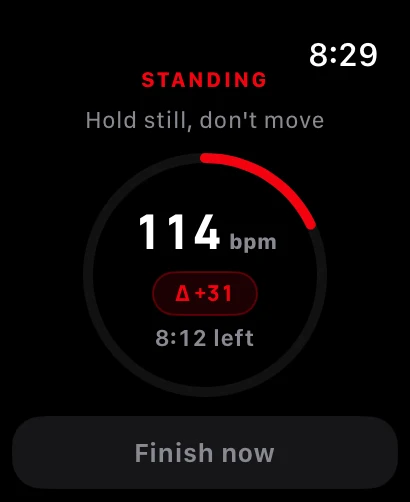
The moment the room tilts, the data’s already there. Check what’s left of today’s budget, run the stand test, catch an episode as it happens, or just keep an eye on your heart rate. No phone, no waiting, nothing to miss.
iPhone + Apple Watch. On Android the same stand test and episode capture run in the app itself, using a Bluetooth chest strap or your phone’s camera.
Lie down and rest quietly. We’ll tell you when to stand.
Check the Autonomic app for more details.
Wellness screening only. HR-based, does not measure blood pressure, and is not a diagnosis. Discuss with your doctor.
First we’ll capture your heart rate before the transition.
Check the Autonomic app for more details.
Wellness screening only. HR-based, does not measure blood pressure, and is not a diagnosis. Discuss with your doctor.
Tap the watch to try it. It’s the real app, with the clocks sped up.
Six ways your watch answers back.
Four tools on the watch itself, your HRV readings, and everything Apple Health brings in. All of it lands in the same journal, scored the same way, with nothing to copy across.
I’ve been through a dozen apps trying to manage my POTS and PEM. I can say without a doubt Autonomic is the BEST one I’ve tried.
On Android, or wearing a Garmin, you are covered.
The watch app is iPhone only. These do the same jobs on every phone.
 Garmin watchesThe Autonomic app for Garmin records your beat-to-beat intervals on the watch and sends them to your phone. You choose on the phone whether it was a morning baseline or paced training.

 Chest strapsA Polar H10, a Coospo H808S or another Bluetooth chest strap gives the cleanest beat-to-beat signal there is, and runs the stand test and episode capture in the app. Polar’s optical Verity Sense, 360 and OH1 work too.
Why heart rate on your wrist matters.
- Needs
- iPhone and Apple Watch
- Free
- Heart rate, tests, HRV
- Pro
- Pacing, POTS results
- Cellular
- Not needed
With POTS and other forms of dysautonomia, the moments that matter rarely happen in a clinic. They happen in the seconds after you stand up from the sofa, halfway up the stairs, in a hot shower or a supermarket queue. A clinic visit sees one heart rate on one afternoon. Your wrist sees all of them.
Seeing your heart rate and how fast it is moving, as it happens, turns a vague “my heart is going crazy” into a number you can act on and come back to. A buzz when it spikes is your cue to sit down, and an episode capture keeps the record so you can show it to your clinician later.
How accurate is a watch?
Optical wrist sensors read heart rate well at rest and while standing still, and less well while you move, when they can lag or miss beats1. For HRV, wrist devices tend to read a little lower than a chest strap, which is the reference used in research2. That matters less than it sounds: what makes a trend trustworthy is the same device, used the same way, so every reading is comparable with the last. If you want the cleanest signal, a chest strap is it, and how accurate HRV wearables are goes into the evidence.
Built for recovery, not training
Most watch apps are built for athletes chasing a personal best. Autonomic is built for people whose best days are the ones they did not overdo. The pacing budget on your wrist shows what is left of today, never a target to hit, and filling it is never the goal.
Sources
Checked November 2026- Accuracy in wrist-worn, sensor-based measurements of heart rate and energy expenditure in a diverse cohort Shcherbina A, Mattsson CM, Waggott D, et al. Journal of Personalized Medicine 7(2):3, 2017. How well wrist sensors, the Apple Watch among them, read heart rate.
- RR interval signal quality of a heart rate monitor and an ECG Holter at rest and during exercise Gilgen-Ammann R, Schweizer T, Wyss T. European Journal of Applied Physiology 119(7):1525–1532, 2019. A chest strap’s beat-to-beat signal against a medical ECG.
Apple Watch questions, answered
Is the Autonomic Apple Watch app on Android?+
The Apple Watch app needs an iPhone. On Android, the stand test and episode capture run in the phone app with a Bluetooth chest strap, HRV readings with a strap or the phone camera, and the Autonomic app for Garmin watches works on both iPhone and Android.
What is free on the watch?+
The live heart rate monitor, stand tests, episode captures and HRV readings run on every plan. Today’s pacing budget on your wrist and reading your POTS results are part of Pro ($7.99 a month or $49.99 a year), and every install starts with 14 days of it.
Do I need a cellular Apple Watch?+
No. Readings and tests taken on the watch wait on it until your iPhone is in reach, then sync. Nothing goes to a server.
How accurate is Apple Watch heart rate for POTS?+
Optical wrist sensors read resting and standing heart rate well, and they can lag or miss beats during movement. For beat-to-beat HRV a chest strap is the cleanest signal there is. What matters most for a trend is using the same device the same way, so your readings stay comparable with each other.
Can I use a Garmin watch instead?+
Yes. The Autonomic app for Garmin records your beats on the watch and sends them to your phone, on iPhone or Android. You choose on the phone whether a reading is a morning baseline or paced training.
Does it replace my medical device?+
No. The watch app is a wellness tool that reads heart rate. It does not measure blood pressure and it is not a diagnosis. Talk to your clinician about what your numbers mean.
About wearables
All app articles →Put it on your wrist tonight.
Free on the App Store, with the watch app included.