ME/CFS
All 13 articles, newest first.
Post-Exertional Malaise: What Long COVID Recovery Depends On Post-exertional malaise is the delayed, disproportionate crash after exertion that defines ME/CFS and shadows long COVID. Here is why the delay makes it dangerous, why pushing through backfires, and how to see it coming. Pacing 101: How to Find and Expand Your Energy Envelope Pacing is the single most important recovery skill for POTS, long COVID and ME/CFS. Here is how to find the edge of your energy envelope, stop the boom-and-bust cycle, and expand your capacity without triggering a crash. Why Am I So Tired? Fatigue in POTS, Long COVID, and Dysautonomia Fatigue is the most common and most dismissed symptom in POTS, long COVID and dysautonomia. Here is what actually drives it, the different kinds of tired, and how to read and pace around it without spiraling. Fibromyalgia and Dysautonomia: The POTS, HRV and Small Fiber Connection Fibromyalgia is more than widespread pain. Its dizziness, racing heart on standing and crushing fatigue point to a nervous system that is struggling to keep its balance, and research keeps finding low HRV, POTS and small fiber damage alongside it. Here is how the pieces fit, how it overlaps with long COVID and ME/CFS, and what you can track. HRV and PEM: What Your Numbers Do Before, During and After a Crash What heart rate variability does before, during and after a PEM crash, what the research shows, and how to use your morning reading without spiraling. The NASA Lean Test at Home: How to Do It Safely and What to Write Down How to do the NASA 10-minute lean test safely at home, what to record each minute, and how clinicians read the heart rate and blood pressure results. CoQ10 for Long COVID and POTS: Does It Help Fatigue and HRV? CoQ10 is one of the most recommended supplements for post-viral fatigue, usually on the strength of its real role in how your cells make energy. The evidence for long COVID specifically is thin, heart failure is the most studied use, with mixed results, the migraine data is stronger, and the honest move is to test your own response. Here is the physiology, what the trials actually show, the ubiquinone-versus-ubiquinol question, the POTS and warfarin cautions, and how to track whether it helps you. Low-Dose Naltrexone (LDN) for Long COVID: How It Works and What to Track Low-dose naltrexone is the same drug used at 50 mg for addiction, given at a fraction of that dose to calm neuroinflammation. Here is the mechanism, the honest state of the evidence in long COVID and ME/CFS, and what to actually watch if it is in the picture. Introducing the Pacing Budget: Know How Much Today Can Take Autonomic now turns your morning readings into a daily pacing budget, measured in minutes of effort. It counts what really costs you, warns you before you cross the line, checks itself two days later, and lives on your Journal, your home screen and your Apple Watch. Heart Rate Zones Explained: Z1 to Z5, and How to Read Them With Dysautonomia Heart rate zones split effort into five bands off your estimated maximum heart rate. Here is what each zone actually does physiologically, why the age formula is only an estimate, and how to read time-in-zone when you have POTS, long COVID or post-exertional malaise. What the Latest Research Says About Long COVID & Dysautonomia (2026) An honest read on where the science stands in 2026: long COVID and ME/CFS increasingly look like related post-viral illnesses with measurable autonomic dysfunction, and the evidence is converging on why. Recovery from Post-Viral Dysautonomia: Turning Data Into Decisions Recovery from POTS and post-viral dysautonomia is slow, noisy and non-linear, which is exactly why it's so easy to lose hope in the day-to-day. Here's how to pace, read your trends, and turn months of scattered data into decisions that actually bend the curve. POTS, Long COVID & MCAS: Why They Travel Together POTS, long COVID, ME/CFS and MCAS overlap so much that many people are told they have several at once. Here's what actually connects them, how they differ, and which parts of each you can track at home.
Autonomic · free app
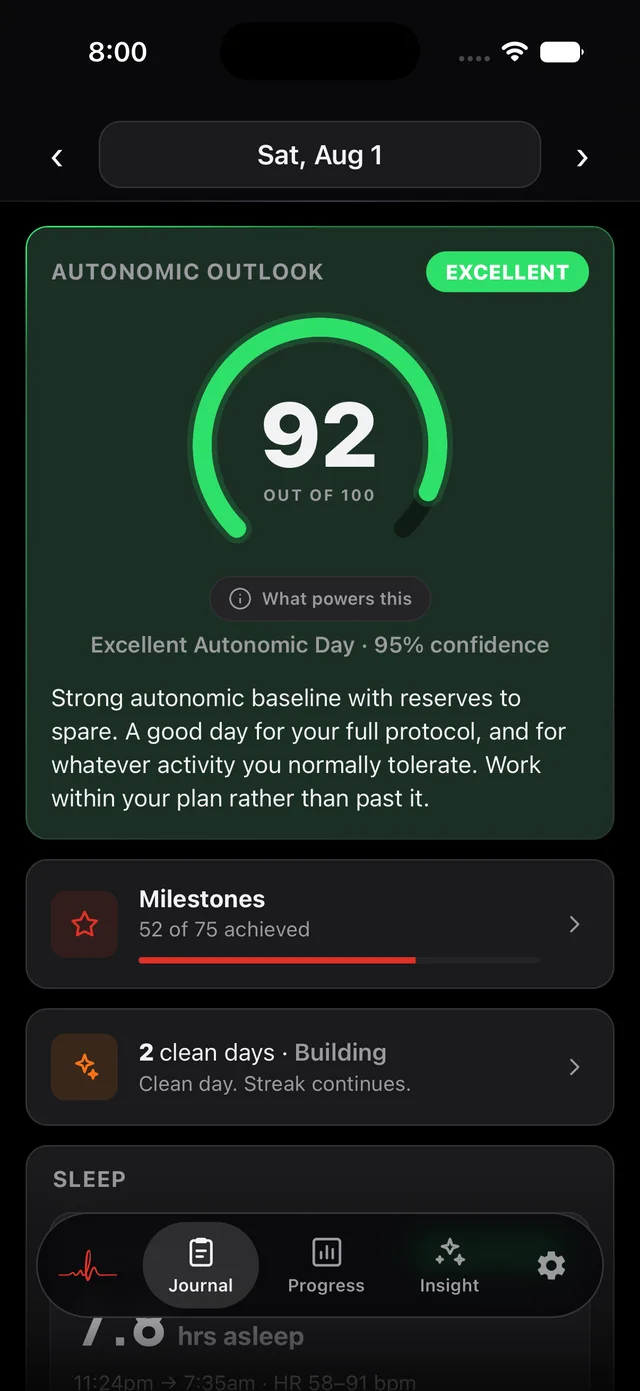
Know what kind of day it is before you get out of bed.
Take a quick heart reading each morning and Autonomic gives you a score out of 100, plus a plain note on how much your body can handle today. So you can plan around a bad day instead of finding out halfway through it.