Dysautonomia
All 83 articles, newest first.
The Autonomic Nervous System & Dysautonomia: A Complete Guide Your autonomic nervous system runs everything you never think about: heart rate, blood pressure, digestion, temperature. When it stops regulating properly, that's dysautonomia. Here is how it works, what goes wrong, and why it's measurable. Nervous System Dysregulation: Signs, Causes, and How to Track Recovery Nervous system dysregulation is when the autonomic balance gets stuck in a sympathetic 'fight or flight' lean and struggles to return to 'rest and digest'. Here is what it actually means, the signs to recognize, and how HRV and resting heart rate let you see it settle over weeks. Fibromyalgia and Dysautonomia: The POTS, HRV and Small Fiber Connection Fibromyalgia is more than widespread pain. Its dizziness, racing heart on standing and crushing fatigue point to a nervous system that is struggling to keep its balance, and research keeps finding low HRV, POTS and small fiber damage alongside it. Here is how the pieces fit, how it overlaps with long COVID and ME/CFS, and what you can track. Orthostatic Load: Why Time on Your Feet Drives POTS Symptoms Orthostatic load is the cumulative gravitational stress of being upright, and for POTS and dysautonomia it often predicts how you feel better than how 'active' you were. Here is what it means, how to spot your own pattern, and how to lower it without giving up your day. Sjögren's and Dysautonomia: Dry Eyes, Dizziness and the POTS Connection Sjögren's is known for dry eyes and a dry mouth, but it is a whole-body autoimmune disease that can reach the autonomic nerves. Dizziness on standing, a racing heart, gut trouble and burning feet can all be part of it, sometimes years before the dryness. Here is how it overlaps with POTS and small fiber neuropathy, how it is diagnosed, and what to track. Melatonin, Sleep and HRV: Does It Help POTS and Dysautonomia? Melatonin is one of the most common sleep supplements in POTS, dysautonomia and long COVID communities, but most people take it wrong: too much, too late, as if it were a sedative. It is really a timing signal. Here is the honest picture of what it does to sleep and HRV, the blood-pressure caution POTS makes worth knowing, why low and early usually beats high and late, and how to test whether it actually helps you. How to Lower a High Heart Rate From POTS in the Moment When your heart rate spikes standing up with POTS, a few fast, drug-free moves can bring it down: change position, use counterpressure, slow your breathing, and get fluid and salt on board. Here is the order that actually helps and how to track what works for you. Yoga for POTS and Dysautonomia: Safe Poses, Breathing, and HRV Yoga can genuinely help POTS and dysautonomia, but the risk isn't the stretching, it's the standing up. Here's which poses are friendly, which to modify, how slow breathing raises vagal tone, and how to practice without triggering a flare. Surgery and Anesthesia with POTS: How to Prepare and Recover Well Surgery with POTS is very doable, but a few predictable things (fasting, dehydration, lying flat, then standing up) can set off a bad flare if nobody plans for them. Here is how to prepare, what to ask your anesthesiologist, and how to recover without a crash. Labile Blood Pressure in Dysautonomia: Why Your BP Swings and How to Track It Labile blood pressure, the kind that climbs and falls through the day instead of holding steady, is a common and often frightening part of dysautonomia. Here is what drives the swings, which patterns are worth knowing, and how to track them at home without spiraling. Tinnitus and Ear Symptoms in Dysautonomia and Long COVID: Why Your Ears Ring, Buzz, and Feel Full Ringing, buzzing, ear fullness, hearing your own pulse, and sound sensitivity are all common in POTS, dysautonomia, and long COVID. Here is why the autonomic nervous system turns the volume up on your ears, how to tell the ordinary kinds from the few that need a clinician, and what to track so a frightening sound becomes a readable signal. Headaches and Migraines in POTS and Dysautonomia: Why Your Head Hurts and What Helps Headaches are one of the most common and least-discussed symptoms of POTS and dysautonomia. Here is the autonomic physiology behind orthostatic headaches and migraines, how to tell the main types apart, the red flags worth knowing, and practical ways to track and ease them. Frequent Urination and Nocturia in POTS and Dysautonomia: Why You Pee So Much Frequent urination, urgency and waking up at night to pee are common in POTS and dysautonomia, and they are not random. Here is the autonomic physiology behind daytime frequency and nocturia, the fluid-shift pattern that soaks your mornings, the red flags worth knowing, and practical steps that help. Counterpressure Maneuvers for POTS: Moves That Stop the Standing Spike Counterpressure maneuvers are simple, drug-free muscle moves that squeeze pooled blood back toward your heart and blunt the lightheadedness and heart-rate spike of standing. Here is how each one works and when to use it. Why Am I So Tired? Fatigue in POTS, Long COVID, and Dysautonomia Fatigue is the most common and most dismissed symptom in POTS, long COVID and dysautonomia. Here is what actually drives it, the different kinds of tired, and how to read and pace around it without spiraling. POTS and Insomnia: Why You're Wired but Tired and Can't Sleep POTS insomnia is the exhausting mismatch between a body that is depleted and a nervous system that will not switch off. Here is why it happens, what the overnight numbers show, and the practical steps that calm the night. Blurry Vision and Visual Symptoms in POTS and Dysautonomia: Why Your Sight Changes When You Stand Blurry vision, graying out, tunnel vision, light sensitivity and dry eyes are common in POTS and dysautonomia, and most of the time they come from your eyes briefly getting less blood when you are upright, not from an eye disease. Here is why vision fades first when you stand, what the different visual symptoms mean, and what to track. Nausea in POTS and Dysautonomia: Why You Feel Sick and What Helps Nausea is one of the most common and most dismissed symptoms of POTS and dysautonomia. Here is the autonomic physiology behind it, how to tell the different triggers apart, the red flags worth knowing, and the practical steps that settle a queasy stomach. Cold Hands and Feet in POTS and Long COVID: Why It Happens and What Helps Cold, pale hands and feet are one of the most common and least talked about parts of dysautonomia. Here is the physiology behind it, how to tell plain cold extremities from Raynaud's and acrocyanosis, and the practical steps that actually warm you up. Electrolyte Drinks for POTS: How to Choose One (and a DIY Recipe) Most sports drinks are far too dilute to help POTS. The number that actually matters is sodium per serving, not the color of the bottle. Here is how to read a label, a comparison of common options, and a cheap recipe you can make at home. Non-Dipping Blood Pressure: Why Yours Should Fall at Night Healthy blood pressure follows a daily rhythm and drops 10 to 20 percent while you sleep. When that night-time fall is missing, clinicians call it 'non-dipping,' and it is one of the quieter autonomic signals worth understanding, especially in dysautonomia. Intermittent Fasting and POTS: What It Does to HRV, and Whether to Try It Intermittent fasting is everywhere, but POTS and dysautonomia change the math. Here is the honest physiology: how fasting moves your HRV, why skipping breakfast can backfire on blood volume and blood sugar, and a gentler way to try it if you still want to. Vitamin B12, Dysautonomia and HRV: The Deficiency Worth Ruling Out Low vitamin B12 can damage the nerves that run your heart rate and blood pressure, which is why it can look and feel a lot like dysautonomia. Here is the honest picture: how a deficiency produces POTS-like symptoms, why the standard serum test misses the grey zone, the confirmatory labs to ask for, why B12 is far safer to correct than vitamin D, and how to track your own response. Why Hot Showers Make POTS Worse: Heat, Blood Pooling, and How to Shower Safely A hot shower stacks three POTS triggers at once: heat that dilates your blood vessels, standing still in the stream, and fluid lost to sweat. Here is why showering leaves so many people dizzy, and a practical, non-scary way to make it safer. Dysautonomia Awareness Month 2026: Ten Mornings, One Giveaway October is Dysautonomia Awareness Month, and this year we are marking it with a giveaway built around the one thing that helps most: getting to know your own nervous system. From October 1, every day you take an HRV reading earns an entry, up to 10. Win an Apple Watch Series 12 or a Polar H10. Vitamin D, HRV and POTS: Does the Sunshine Vitamin Move the Needle? Vitamin D deficiency is common in people who are chronically ill and less active, and low levels are linked with worse cardiac autonomic function. Here is the honest picture: where the evidence for HRV is real and where it is thin, why 25(OH)D is the test that matters, the POTS angle, the toxicity caution that makes vitamin D different from magnesium, and how to test your own response. Pulse Oximeter Readings in Long COVID and POTS: What SpO2 Can and Cannot Tell You A fingertip pulse oximeter measures how much oxygen your blood is carrying, and in long COVID and POTS that number is usually normal even on the days you feel most breathless. Here is how to read SpO2 accurately, why a normal reading does not mean nothing is wrong, and what to watch for. Chest Pain and Tightness in POTS and Dysautonomia: What It Usually Is Chest pain and tightness are common and frightening in POTS, long COVID and dysautonomia, and in a young person with a structurally normal heart they are usually not cardiac. Here is what actually produces the sensation, how to sort the type you feel, and the red flags that mean call for help now. Dizziness and Lightheadedness in POTS and Dysautonomia: Why It Happens and What to Track Dizziness and lightheadedness are the most common symptoms of POTS and dysautonomia, and most of the time they come from the brain briefly getting less blood when you are upright, not from your inner ear. Here is how to tell the types apart, why standing sets it off, and what to track. Internal Tremors and Vibrations in Long COVID and Dysautonomia Internal tremors are a shaking or buzzing you feel inside your body with little or nothing to see on the outside. They are common in long COVID, POTS, and dysautonomia, and there is a clear autonomic reason. Here is what drives them and how to read the pattern calmly. Sweating and Dysautonomia: Too Much, Too Little, and Night Sweats Sweating is run entirely by your autonomic nervous system, so when that system is dysregulated your sweating often is too, in either direction. Here is why POTS, long COVID, and other forms of dysautonomia can cause drenching sweats, night sweats, or the opposite, and how to read the pattern calmly. Thyroid and HRV: Why Your Thyroid Can Mimic POTS and Lower Your Numbers An overactive or underactive thyroid can raise your heart rate, drop your HRV, and feel a lot like POTS. Here is how thyroid hormone shapes your autonomic numbers, why it is worth ruling out, and how to track the difference at home. Low-Dose Naltrexone (LDN) for Long COVID: How It Works and What to Track Low-dose naltrexone is the same drug used at 50 mg for addiction, given at a fraction of that dose to calm neuroinflammation. Here is the mechanism, the honest state of the evidence in long COVID and ME/CFS, and what to actually watch if it is in the picture. POTS in Teenagers: What Adolescent POTS Looks Like and Why It Often Gets Better POTS most often begins in the teen years, frequently after a virus, a growth spurt, or a concussion. The diagnostic threshold is higher for adolescents, and the outlook is more hopeful than for adults. Here is how teenage POTS behaves and how to track it at home. POTS Flare-Ups: What Triggers Them and How to Recover A POTS flare is a temporary spell of amplified symptoms above your usual baseline, set off by things like heat, illness, hormones or overexertion. Here is how to recognize a flare, what tends to trigger one, and a calm, step-by-step way to recover. POTS and Pregnancy: What to Expect Trimester by Trimester Most people with POTS have healthy pregnancies, but symptoms shift as blood volume, hormones and heart rate change. Here is what tends to happen in each trimester, and how to read your own numbers without panic. Flying with POTS: How to Survive Air Travel with Dysautonomia Air travel stacks nearly every POTS trigger into one day: dehydration, low cabin oxygen, hours of sitting, missed sleep, and long stretches on your feet in the terminal. Here is what a flight actually does to your autonomic nervous system, and a practical plan for before, during, and after so you land closer to your baseline instead of flat on it. Clonidine and Guanfacine for Hyperadrenergic POTS: Turning Down the Sympathetic Signal Clonidine and guanfacine work from the opposite end of a beta blocker: instead of blocking adrenaline at the heart, they quiet the sympathetic signal at its source in the brainstem. Here is how these central alpha-2 agonists are used in hyperadrenergic POTS, how the two differ, and what to track once one is in the picture. Menopause, Perimenopause, and HRV: Hormones, Palpitations, and Dysautonomia As estrogen swings and falls through perimenopause and menopause, HRV tends to drop, resting heart rate ticks up, and palpitations and orthostatic symptoms often flare. Here is what actually changes, and how to read your numbers through the transition without spiraling. Pyridostigmine (Mestinon) for POTS: The Drug That Raises Vagal Tone to Slow a Standing Heart Rate Pyridostigmine lowers the standing tachycardia of POTS from an unusual direction: it lets acetylcholine build up, which strengthens vagal tone and eases ganglionic transmission, so heart rate comes down without lowering blood pressure. Here is how it works, what the evidence shows, the cholinergic side effects, and what to actually track. Gastroparesis and POTS: Nausea, Bloating, and Slow Digestion in Dysautonomia Feeling full after a few bites, nauseous, and bloated for hours is common in POTS and dysautonomia, and delayed gastric emptying is often the reason. Here is why the same nervous system that controls your heart rate also controls your stomach, how to tell gastroparesis apart from post-meal blood pooling and blood-sugar swings, and the eating patterns that help. Autonomic Function Tests: What to Expect at Autonomic Testing Referred for autonomic testing and not sure what happens? Here is a plain walk through the standard autonomic reflex screen: the deep breathing test, the Valsalva maneuver, the tilt table, and the QSART sweat test, plus how each result is read. Blood Sugar Swings and POTS: Reactive Hypoglycemia, Explained If you feel shaky, sweaty, and your heart races a couple of hours after a carb-heavy meal, a blood-sugar swing may be feeding your POTS symptoms. Here is the physiology of reactive hypoglycemia, why it overlaps so cleanly with adrenaline surges, and how to flatten the curve. Why Are All My Test Results Normal When I Feel This Sick? Your ECG, bloodwork and echo came back normal, but you can barely stand up without your heart pounding. Here is why 'normal' and 'this sick' can both be true, what standard tests miss in dysautonomia, and the exact evidence to bring back to your clinician. Coat Hanger Pain: Why Your Neck and Shoulders Ache When You Stand Coat hanger pain is the aching band across the back of the neck and shoulders that builds the longer you stay upright and eases when you lie down. Here is why it happens in POTS and orthostatic intolerance, how to tell it apart from ordinary neck tension, and how to track it. Tilt Table Test: What to Expect and How It Diagnoses POTS and Syncope A tilt table test tips you upright on a motorized table while your heart rate and blood pressure are watched continuously. Here is what actually happens during the test, how it is read, and how it differs from the stand test you can run at home. Heart Palpitations and Ectopic Beats in POTS: What They Mean and How They Affect HRV Palpitations, that pounding, fluttering or skipped-beat feeling, are one of the most common and most frightening symptoms in POTS and long COVID. Here is what the different sensations actually mean, why most are benign, the red flags that are not, and how ectopic beats quietly distort your HRV readings. Small Fiber Neuropathy in POTS and Long COVID: Symptoms, Testing, and What to Track Small fiber neuropathy damages the tiny nerves that carry pain, temperature and autonomic signals, and it shows up surprisingly often in POTS and long COVID. Here is what it feels like, how it is tested, and the at-home metrics that mirror the autonomic side of it. Low Blood Volume in POTS: How Hypovolemia Drives the Racing Heart Many people with POTS run on a genuinely smaller blood volume than average. Here is the physiology behind hypovolemic POTS, why it drives the standing tachycardia and low HRV, and the at-home fingerprints you can actually track. Hypermobility, hEDS and POTS: Why Bendy Joints and a Racing Heart Travel Together Joint hypermobility, hypermobile Ehlers-Danlos syndrome (hEDS) and POTS overlap far more often than chance. Here is the connective-tissue link, what the Beighton score does and does not tell you, and how tracking changes the management. Weather and POTS: How Barometric Pressure, Humidity, and Cold Shift Your Symptoms Many people with POTS and dysautonomia swear their symptoms track the weather, and the physiology backs up a lot of it. Here is what barometric pressure, humidity, cold snaps, and passing fronts actually do to an autonomic nervous system, and how to tell whether the sky is really your trigger. Heart Rate Zones Explained: Z1 to Z5, and How to Read Them With Dysautonomia Heart rate zones split effort into five bands off your estimated maximum heart rate. Here is what each zone actually does physiologically, why the age formula is only an estimate, and how to read time-in-zone when you have POTS, long COVID or post-exertional malaise. Sleep Apnea and HRV: Why It Keeps Your Nervous System on Edge Undiagnosed sleep apnea is one of the most common hidden reasons HRV stays stuck low and morning heart rate runs high. Here is the physiology, how it shows up in your own overnight and morning numbers, and why the POTS and long COVID crowd gets missed. From Daily Crashes to Living Again: What I Tracked, What I Changed, and What the Data Showed A patient-founder's honest account of four years with long COVID and dysautonomia: the daily crashes and labile blood pressure, why I started measuring, the routine I built piece by piece, and what my own HRV and blood pressure data actually showed. Iron Deficiency and POTS: Why Ferritin Matters When Your Labs Look Normal Low iron stores are common in POTS and can quietly amplify tachycardia, fatigue and lightheadedness, often while a standard blood count still reads normal. Here is how ferritin fits in, why the lab range can miss it, and what to track at home. Compression Garments for POTS: What Actually Works and How to Wear Them Compression is one of the few non-drug tools with real evidence behind it for POTS. The catch: where you compress matters far more than most people realize. Here is what the research shows and how to use it. Is It POTS or Anxiety? How to Tell Them Apart POTS and anxiety share almost every symptom: racing heart, dizziness, shortness of breath, that wired feeling. The one thing that reliably separates them is what your heart does when you stand up. Here is how to read the difference without spiraling. Why Are POTS Symptoms Worse in the Morning? The Overnight Physiology and a Gentler Start If your POTS symptoms are at their worst in the first hour after waking, there are real, well-understood reasons. Here is what happens to your blood volume, hormones and heart rate overnight, and a calmer, step-by-step way to get out of bed. Long COVID Brain Fog: The Autonomic Connection (and How to Track the Pattern) Long COVID brain fog is not just fatigue in disguise. A large part of it tracks with your autonomic nervous system, especially how your body handles being upright. Here is the physiology in plain language, and how to find your own pattern. Why POTS Feels Worse After Eating: Postprandial Hypotension, Explained If your heart races, your head swims, or you crash for an hour after a meal, that is not in your head. Digestion pulls a large share of your blood into the gut, and a struggling autonomic system cannot compensate. Here is the physiology and how to eat around it. POTS Subtypes Explained: Hyperadrenergic, Neuropathic, and Hypovolemic POTS is usually grouped into three overlapping patterns: neuropathic, hyperadrenergic, and hypovolemic. Here is what each one means, how they differ, and what your at-home stand-test numbers can hint about which pattern is driving your symptoms. See Your Nervous System Recover Dysautonomia is invisible, and that's half of what makes it so hard: you can't see the illness, and you can't see the recovery either. Autonomic is the app that makes recovery visible: HRV, blood pressure, stand tests and sleep, scored, trended, and kept private on your phone. Adrenaline Dumps in POTS: Why Your Heart Races (and Why It Usually Isn't a Panic Attack) That sudden racing heart, tremor and wave of dread, often at 3am or after standing, has a name patients use: an adrenaline dump. Here is the physiology behind catecholamine surges in POTS, how to tell them apart from panic attacks, and how to track and settle them. Heat Intolerance and POTS: Why Hot Weather Wrecks Your Numbers (and How to Track It) Heat is one of the most reliable triggers in POTS and dysautonomia. Here is the physiology behind why hot weather raises your heart rate, drops your HRV, and worsens standing symptoms, plus the practical cooling and tracking moves that actually help. Alcohol and HRV: Why a Few Drinks Lower Your Overnight Numbers (and Flare POTS) Unlike caffeine, alcohol reliably lowers your overnight HRV, and the effect scales with how much you drink and how late. Here is the physiology, honestly, plus why it hits POTS and dysautonomia harder, and how to test your own response. The Menstrual Cycle and HRV: Why Your Numbers Dip (and POTS Flares) Before Your Period HRV tends to run higher in the follicular half of your cycle and lower in the luteal half, while resting heart rate does the opposite. Knowing where you are in your cycle keeps a normal luteal dip from reading like a crash, and explains why POTS symptoms so often flare before and during your period. Caffeine and POTS: How Coffee Affects Your Heart Rate, HRV, and Standing Symptoms Does coffee make POTS worse? Caffeine is a stimulant that raises heart rate and sympathetic drive, but it can also nudge blood pressure up and its effect on HRV is genuinely individual. Here is the physiology, honestly, plus how to test your own response. What the Latest Research Says About Long COVID & Dysautonomia (2026) An honest read on where the science stands in 2026: long COVID and ME/CFS increasingly look like related post-viral illnesses with measurable autonomic dysfunction, and the evidence is converging on why. Recovery from Post-Viral Dysautonomia: Turning Data Into Decisions Recovery from POTS and post-viral dysautonomia is slow, noisy and non-linear, which is exactly why it's so easy to lose hope in the day-to-day. Here's how to pace, read your trends, and turn months of scattered data into decisions that actually bend the curve. POTS, Long COVID & MCAS: Why They Travel Together POTS, long COVID, ME/CFS and MCAS overlap so much that many people are told they have several at once. Here's what actually connects them, how they differ, and which parts of each you can track at home. Autonomic: Measure, Analyze, Monitor, Act Everything about autonomic recovery comes down to one loop: measure what's happening, analyze the trend, monitor for warnings, and act. Autonomic is the app built to close that loop: private, offline, and scored against medical thresholds. What Recovery Actually Looks Like: The Non-Linear Curve Recovery from post-viral dysautonomia and POTS is real but slow, and it almost never moves in a straight line. Here is what the honest timeline looks like, why plateaus mislead you, and what to watch instead of the daily noise. Is It Long COVID or POTS? How to Tell Them Apart Long COVID and POTS are not competing labels: one is a broad umbrella and the other a specific, measurable diagnosis that often sits inside it. Here is how to tell what you are actually dealing with. SIBO, Histamine & Why Dysautonomia Wrecks Digestion Dysautonomia doesn't stop at your heart rate, it slows your gut, invites bacterial overgrowth, and can stir up histamine problems. Here is how POTS, SIBO and MCAS feed each other, and the dietary tools that actually help. Does HRV Biofeedback Work for Long COVID? The Evidence Slow resonant breathing is one of the gentlest things you can try for long COVID dysautonomia. Here is what the actual studies found, where they fall short, and how to judge whether it is worth your energy. Sleep and Autonomic Recovery: Your Biggest Daily Lever Most of your parasympathetic restoration happens overnight, which makes sleep the single biggest lever you have on autonomic recovery. Here is how dysautonomia disrupts it, and gentle, realistic ways to sleep better. What Causes Long COVID? Microclots, Neuroinflammation & Autonomic Injury The leading 2026 theories for what drives long COVID overlap rather than compete: persistent inflammation, microclots, small-fiber nerve damage, autoantibodies and autonomic injury. Here is what each one may explain about how you feel. What HRV Actually Is, And Why It Matters for POTS Recovery Heart rate variability is one of the clearest windows into your autonomic nervous system. Here is what it measures, why it drops in POTS and post-viral illness, and how to read it without obsessing. The Orthostatic Stand Test: How to Do It at Home (and What the Numbers Mean) The lying-to-standing heart rate test is the single most useful at-home measurement for POTS. Here is how to run it consistently and how to read the rise and recovery. Long COVID Symptoms That Point to Dysautonomia Racing heart on standing, dizziness, brain fog, exertion crashes and temperature swings after COVID often share one root: a dysregulated autonomic nervous system. Here is how to recognize the pattern and what to do next. Turn Months of Data Into a Five-Minute Doctor Conversation Appointments are short and symptoms are hard to describe from memory. Here is how to use your own tracked data to walk in with a clear, specific summary your clinician can act on. Why We Built Autonomic Offline-First: Privacy as Architecture Health data is some of the most sensitive information you own, yet most apps ship it to the cloud. Autonomic keeps everything on your phone. Here is why that is a design choice, not a settings toggle. How POTS Is Diagnosed: The 30-BPM Rule, the Tilt Table & What to Expect POTS is diagnosed by a sustained heart-rate rise on standing without a big blood-pressure drop, symptoms lasting months, and other causes ruled out. Here is what the criteria mean and what the tests feel like.
Autonomic · free app
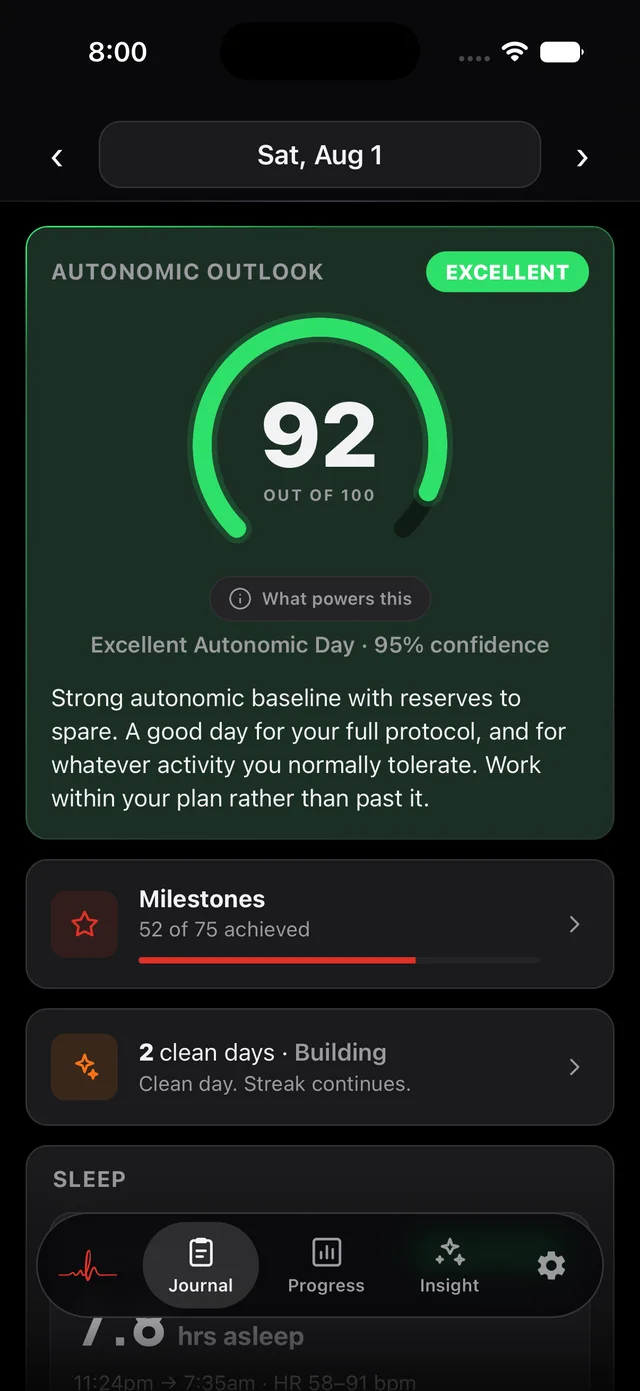
Know what kind of day it is before you get out of bed.
Take a quick heart reading each morning and Autonomic gives you a score out of 100, plus a plain note on how much your body can handle today. So you can plan around a bad day instead of finding out halfway through it.