Just diagnosed
New to POTS, long COVID, ME/CFS or dysautonomia? Start here: what the diagnosis means, the tests, the first treatments, and how to begin tracking.
Where to start
A new diagnosis of POTS, long COVID, ME/CFS or dysautonomia can bring relief and a lot of questions at once. Relief, because there is finally a name for what has been happening. Questions, because the name does not come with a manual.
The good news is that the first steps are well understood. For POTS that usually means more salt and fluids and compression garments, and for all of these conditions it means pacing to stay out of crashes and slowly rebuilding what your body can handle. Medication helps some people, and it works best on top of those basics.
It also helps to start tracking early. A few weeks of morning readings and notes on how you feel give you and your doctor something solid to work from, and they make progress visible when it is hard to feel.
Read these 5 first.
What is going on, what to try first, and what to expect.
About 26 minutes total
- 01 The Autonomic Nervous System & Dysautonomia: A Complete GuideWhat is actually going on in your body. · 6 min
- 02 POTS Treatment: Salt, Fluids, Compression & Medication ExplainedThe first treatments most people try. · 6 min
- 03 Pacing 101: How to Find and Expand Your Energy EnvelopeHow to stop the crash cycle. · 6 min
- 04 What Recovery Actually Looks Like: The Non-Linear CurveWhat getting better tends to look like. · 6 min
- 05 Turn Months of Data Into a Five-Minute Doctor ConversationMaking the most of your appointments. · 2 min
Everything for your first months
Understanding the diagnosis
6What it means, the tests, and the types.
The Autonomic Nervous System & Dysautonomia: A Complete GuideHow POTS Is Diagnosed: The 30-BPM Rule, the Tilt Table & What to ExpectPOTS Subtypes Explained: Hyperadrenergic, Neuropathic, and HypovolemicTilt Table Test: What to Expect and How It Diagnoses POTS and SyncopeAutonomic Function Tests: What to Expect at Autonomic TestingShow 1 moreShow fewer
POTS, Long COVID & MCAS: Why They Travel TogetherFirst steps
4Treatment basics, pacing, and starting to track.
POTS Treatment: Salt, Fluids, Compression & Medication ExplainedPacing 101: How to Find and Expand Your Energy EnvelopeHRV: The Complete Guide to Reading Your Nervous SystemTurn Months of Data Into a Five-Minute Doctor ConversationWhat comes next
2How recovery tends to go, and how to steer it.
Recovery from Post-Viral Dysautonomia: Turning Data Into DecisionsWhat Recovery Actually Looks Like: The Non-Linear CurveStart your record now, before your next appointment.
A few weeks of morning readings and stand tests give your doctor something real to look at, in a summary you can bring.
- How much does standing cost me?A home stand test measures how far your heart rate climbs when you get up.
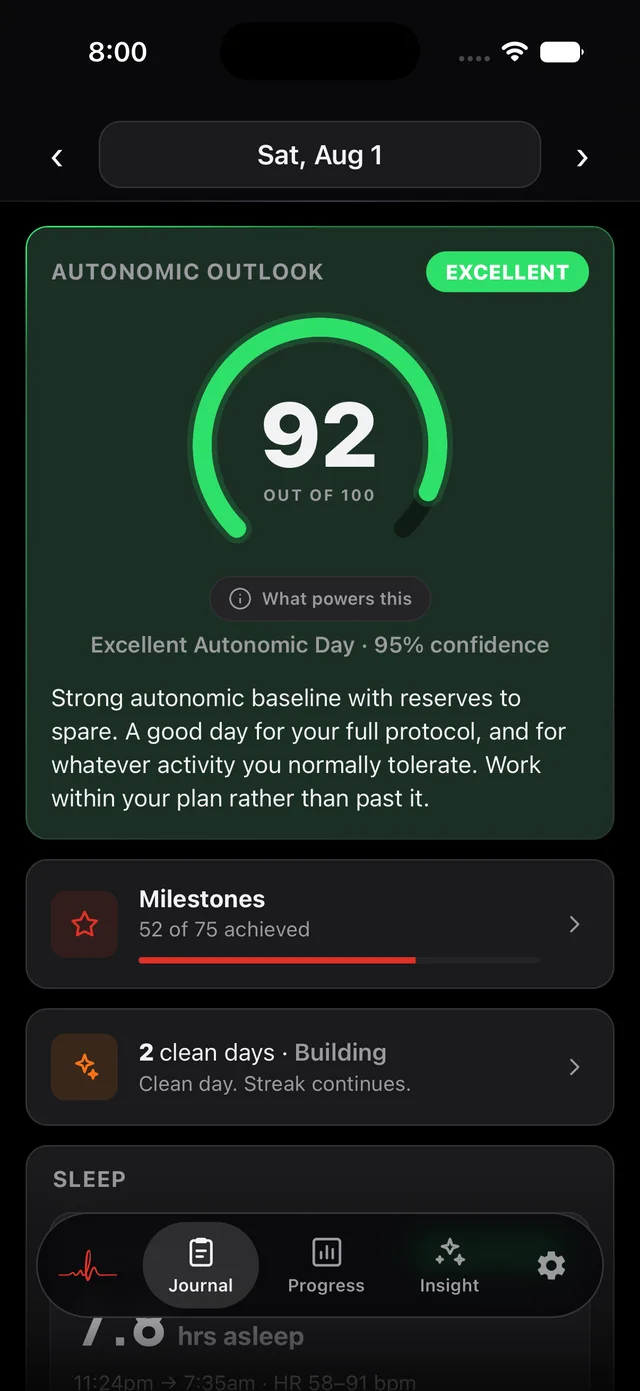
- What kind of day is it?A morning heart reading becomes a score out of 100, before you get out of bed.
- What do I tell my doctor?Turn weeks of your own numbers into a summary for your next appointment.


4.9 on the App Store · Free to start · Your data stays on your phone
Newest on Just diagnosed


Know what kind of day it is before you get out of bed.
Take a quick heart reading each morning and Autonomic gives you a score out of 100, plus a plain note on how much your body can handle today. So you can plan around a bad day instead of finding out halfway through it.