




Social posts for this article
The short answer
A common, conservative starting point is your resting heart rate plus 15 beats per minute, which is what the Workwell Foundation recommends when you have not had a 2-day exercise test.Age-based formulas such as 50 to 60 percent of 220 minus your age usually give a higher number, and in ME/CFS the threshold often sits lower than those formulas expect. If you have had a 2-day CPET, the heart rate at your ventilatory threshold on day two is the most personal number available. Whatever you start with, treat it as a hypothesis and check it against how you feel over the next two days.
If you pace with a heart rate monitor, you have probably met the same frustrating problem: every source gives you a different number, and the gap between them can be 25 beats or more. A conservative heart rate limit for pacing is your resting heart rate plus 15 beats per minute, unless a 2-day exercise test has given you a measured threshold. That is a starting point, not a verdict, and the rest of this page is about where the numbers come from and how to tell whether yours fits.
The idea behind heart rate pacing is simple. Somewhere above your resting rate is the point where your body leans harder on anaerobic energy, often called the anaerobic or ventilatory threshold. In ME/CFS and in long COVID with post-exertional malaise, time spent above that point is one of the things that seems to set up a crash a day or two later. A heart rate ceiling is a way of seeing that point coming while you are still below it.
Is there one heart rate limit that works for everyone?
No. There are four common ways people set a pacing limit, and they rest on different assumptions. In an international survey of 488 people with ME/CFS who paced with a heart rate monitor, the most common answer to “how did you set your limit” was that they were still searching for it (31.4%). The rest were split between 60 percent of 220 minus age (19%), resting heart rate plus 15 (13.4%), 50 percent of 220 minus age (11.9%), 55 percent (10.6%) and a 2-day exercise test (3.2%) (Clague-Baker et al., 2023).
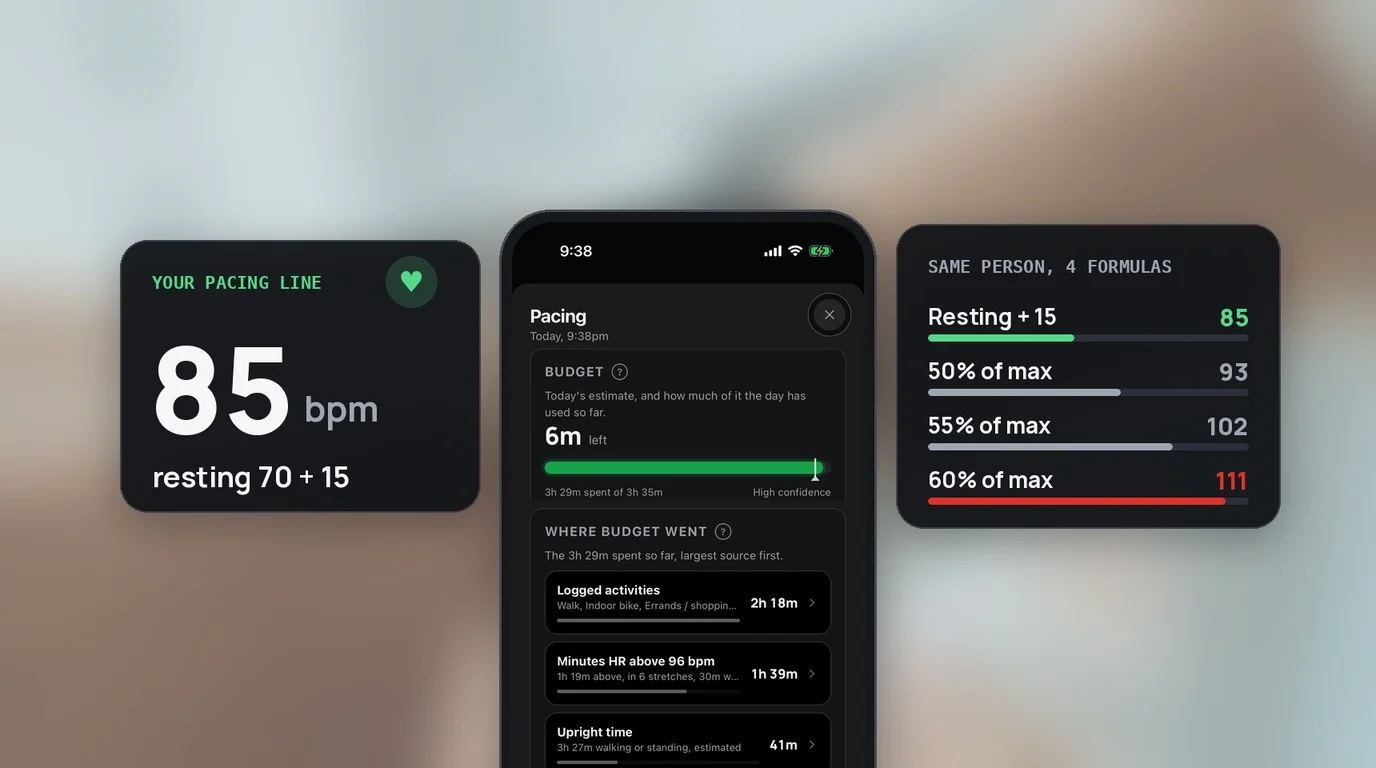
Here is how the options compare, using one example: a 35-year-old whose morning resting heart rate averages 70.
| Method | Where it comes from | Example (age 35, resting 70) | Watch out for |
|---|---|---|---|
| Resting heart rate + 15 | Workwell Foundation’s starting estimate | 85 bpm | A high resting rate in POTS raises it too |
| 50% of 220 minus age | Common pacing rule of thumb | 93 bpm | Assumes a normal heart rate response |
| 55% of 220 minus age | Emerge Australia’s rough estimate | 102 bpm | Same assumption, higher number |
| 60% of 220 minus age | Most popular in the survey | 111 bpm | Often too high for ME/CFS |
| Day two of a 2-day CPET | Measured ventilatory threshold | Your own result | Costly, can cause a crash, not widely available |
Where does resting heart rate plus 15 come from?
It comes from the Workwell Foundation, a group in California that runs 2-day exercise testing for ME/CFS and has done much of the research on it. Their guidance is plain: “Workwell recommends RHR + 15 beats as a starting point for estimating the V/AT,” and they advise against the standard age-based formula (Workwell Foundation, 2024).
The reasoning is that many people with ME/CFS have a blunted heart rate response to exercise. A research group from the same circle describes this as chronotropic intolerance: the heart rate does not rise as much as expected during effort, so the heart cannot increase its output the way it should, and smaller heart rate increases during exercise testing are “consistently observed in ME/CFS” (Davenport et al., 2019). If your heart rate climbs less than a textbook expects, a threshold calculated from a textbook maximum will be too high.
To get the resting number right, Workwell suggests taking your heart rate after waking but before getting out of bed, then averaging a week of those readings. A single morning can be thrown off by a bad night, so the average matters more than any one reading.
What about 50 to 60 percent of your max?
These formulas take an estimated maximum heart rate, usually 220 minus your age, and use a slice of it. Emerge Australia, for example, describes 55 percent of your age-predicted maximum as “a rough estimate” of the anaerobic threshold for people with ME/CFS, while adding that only an exercise test can establish it accurately (Emerge Australia).
There are two problems stacked here. The first is that 220 minus age is a rough guess at your maximum. A large meta-analysis of 18,712 people found a better fit with 208 minus 0.7 times age, and even then real maximums scattered around the prediction by about 10 beats per minute in healthy adults (Tanaka et al., 2001). The second is the blunted response above: if you cannot reach the maximum the formula assumes, every percentage of it is inflated. We go deeper on maximum heart rate formulas in heart rate zones explained.
That does not make age formulas useless. For someone whose resting heart rate is very low, or who has found resting plus 15 far too restrictive without any crash, a percentage formula can be a reasonable second guess. It just should not be the first one.
Why is a 2-day exercise test the gold standard?
A cardiopulmonary exercise test (CPET) measures your breathing gases while you cycle to exhaustion, which pins down your ventilatory threshold and the heart rate at which you reach it. The ME/CFS version repeats the test 24 hours later, because the second day is where the illness shows itself.
In a Dutch study of 82 women with ME/CFS, the workload they could manage at the ventilatory threshold dropped on day two in every severity group: from 69 to 50 watts in mild disease, 61 to 41 in moderate and 53 to 36 in severe, falls of 26 to 33 percent (van Campen et al., 2020). An earlier American study of 51 women with ME/CFS and 10 controls found that day two results separated the two groups with 95.1% accuracy (Snell et al., 2013).
That is why Workwell recommends pacing to the threshold heart rate from day two, not day one. Day two is your body in the state it actually lives in after exertion. The trade-off is real, though: a 2-day CPET is expensive, few clinics offer it, and the test itself can trigger a significant crash. Most people pace on an estimate for that reason, and only 3.2% of the survey respondents had a CPET-based number.
What is my starting number?
Enter your age and your average morning resting heart rate. If you have had a 2-day CPET, add the heart rate at your ventilatory threshold from day two and the calculator will use that instead.
Pacing heart rate starting point
Why can heart rate alone miss a crash?
A heart rate ceiling is good at catching physical effort that you might not notice building, like a long walk or carrying shopping. It is much less good at the rest of what costs you, and it helps to know where its blind spots are.
Standing up. In POTS and orthostatic intolerance, heart rate rises from posture and blood pooling, not only from effort. Standing still at a counter can push you over a pacing line while your legs do nothing. That alarm is still telling you something real, because upright time is genuinely expensive, but it means a strict ceiling may be impossible to keep while upright. Emerge Australia makes the same point about orthostatic intolerance. A stand test can show how much of your heart rate is posture.
Medication. Beta blockers and other rate-controlling medicines cap how fast your heart can go, so effort that would normally push you over a line may not. If you take one, perceived effort deserves more weight than the number. See beta blockers and HRV for more.
Thinking and feeling. Cognitive and emotional exertion count toward your energy envelope but often move heart rate only a little. Workwell notes that crashes can happen even under the threshold, and that cognitive exertion is one reason why.
Lag and wrist readings. Optical heart rate on a watch can lag behind a sudden effort and can be less reliable while you move your arms. A few seconds over the line on a watch is noise; a stretch of minutes is a signal.
How do you know if your number is right?
The honest test is the next 48 hours. Post-exertional malaise usually arrives late, often a day or two after the trigger, so how you feel at the end of the day says little about whether the day fit.
A practical way to check your number:
- Set your watch alarm at your starting number and stop to rest when it goes off. Workwell suggests avoiding more than about two minutes above it where you can, and resting until your heart rate is back within ten beats of your resting rate.
- Log what you did and how you felt for the following two days. Note anything that went over the line and for how long.
- If you keep crashing while staying under it, lower it by a few beats and look at what else filled those days: upright time, a stressful conversation, a bad night.
- If you have had several steady weeks with no crashes, it may be safe to edge it up slowly, a few beats at a time, watching the two days after each change.
- Watch your mornings. A resting heart rate that creeps up or an HRV that dropped overnight is often the first sign that yesterday cost more than it looked. We cover what HRV does before a crash in HRV and PEM.
The evidence that heart rate pacing helps is still mostly self-reported. In the survey above, nearly all respondents said they had found some benefit, most often understanding their PEM triggers (72%) and getting real-time feedback (69%), while 2.2% felt they had been harmed and 4.1% thought they might have been (Clague-Baker et al., 2023). That is encouraging, but it is a survey of people who chose to use monitors, not a trial. Heart rate pacing is also different from graded exercise therapy, which the UK’s NICE guideline says should not be offered to people with ME/CFS because it relies on fixed incremental increases in activity (NICE NG206). For the broader practice of staying inside your limits, start with pacing 101.
The bottom line
If you have never had an exercise test, start with your resting heart rate plus 15 beats per minute, measured lying down after waking and averaged over a week. Age-based formulas usually give a higher number and often overestimate the threshold in ME/CFS. If you have had a 2-day CPET, pace to your day two threshold heart rate. Then let the next two days, not the formula, decide whether the number stays, comes down or slowly goes up.
Sources
- Christian C. Pacing with a heart rate monitor to minimize post-exertional malaise (PEM) in ME/CFS and long COVID. Workwell Foundation, 2024.
- Clague-Baker N, Davenport TE, Madi M, et al. An international survey of experiences and attitudes towards pacing using a heart rate monitor for people with myalgic encephalomyelitis/chronic fatigue syndrome. Work, 2023.
- van Campen CMC, Rowe PC, Visser FC. Two-day cardiopulmonary exercise testing in females with a severe grade of myalgic encephalomyelitis/chronic fatigue syndrome: comparison with patients with mild and moderate disease. Healthcare, 2020.
- Snell CR, Stevens SR, Davenport TE, VanNess JM. Discriminative validity of metabolic and workload measurements for identifying people with chronic fatigue syndrome. Physical Therapy, 2013.
- Davenport TE, Lehnen M, Stevens SR, et al. Chronotropic intolerance: an overlooked determinant of symptoms and activity limitation in myalgic encephalomyelitis/chronic fatigue syndrome? Frontiers in Pediatrics, 2019.
- Tanaka H, Monahan KD, Seals DR. Age-predicted maximal heart rate revisited. Journal of the American College of Cardiology, 2001.
- Emerge Australia. Pacing with a heart rate monitor. Fact sheet, 2023.
- National Institute for Health and Care Excellence. Myalgic encephalomyelitis (or encephalopathy)/chronic fatigue syndrome: diagnosis and management (NG206). 2021.
Questions people also ask about this
What is resting heart rate plus 15?+
It is a simple way to estimate a heart rate ceiling for pacing without an exercise test. You measure your resting heart rate each morning after waking, before you get out of bed, average it over a week, and add 15 beats per minute. The Workwell Foundation, which runs 2-day exercise testing for ME/CFS, recommends it as a conservative starting estimate of the anaerobic threshold.
Should I use 220 minus my age to set my pacing heart rate?+
You can, but treat the result with caution. Percentages of 220 minus age, usually 50 to 60 percent, are popular and are what about a fifth of people in one large ME/CFS survey used. They tend to give a higher number than resting heart rate plus 15, and the Workwell Foundation advises against age-based formulas because many people with ME/CFS have a blunted heart rate response, so their real threshold sits lower than an age formula predicts.
Why is the day two number from a 2-day CPET lower?+
In ME/CFS, a second maximal exercise test 24 hours after the first often shows a lower capacity, including at the ventilatory threshold. In one study of 82 women with ME/CFS, the workload they could manage at that threshold fell by about a quarter to a third on day two. Day two reflects your body in the state you live in after exertion, which is why it is the number Workwell suggests pacing to.
Is it OK to go over my heart rate limit for a moment?+
Brief spikes happen, from stairs, standing up or a sudden noise. The Workwell Foundation suggests avoiding more than about two minutes above your threshold where you can, and when your alarm goes off, stopping to rest until your heart rate is back within ten beats of your resting rate. What tends to matter most is how many minutes you spend above your line across a day, not a single touch of it.
Can I still crash if I stay under my heart rate limit?+
Yes. A heart rate ceiling only sees part of what costs you. Long periods upright, cognitive work, emotional stress, heat and poor sleep can all add to your load without pushing your heart rate past the line, and your limit may simply be set too high. If you keep crashing while staying under it, lower it and look at what else filled those days.
Written by
Austin Spaeth
Austin builds Autonomic, a private, offline journal for tracking autonomic recovery. He writes about HRV, POTS, dysautonomia and post-viral illness for the people living it, turning messy day-to-day data into signals you can actually act on.


