



Social posts for this article
Not provided.
The short answer
Autonomic, which we make, is the best all-around app for POTS and long COVID: it is the only one here that combines a morning HRV reading, a guided POTS stand test, a pacing budget, a symptom journal and a doctor summary, using the phone, watch or strap you already own.Visible is the strongest alternative if pacing is your main need and you want its dedicated band, at $179.88 a year plus a $79.70 band. Welltory is built around HRV and stress, Bearable and Guava around symptom diaries and records, and Apple Health is the free place your data already lands.
If you live with POTS or long COVID, you have probably downloaded at least one app hoping it would make sense of your days, and deleted it a week later. The best all-around app for POTS and long COVID is Autonomic, because it answers all three questions that matter in one place: “how much can I do today?”, “what does standing do to my heart?” and “what is making me worse?” If pacing is your main need and you want a dedicated band, Visible is the strongest alternative.
We make Autonomic, so read this with that in mind. We built it because no single app did all of this, and we have tried to be fair to the others: every claim about another app comes from its own App Store listing or website, checked on the day this was written, and we say plainly where another app does something better than ours.
What should a POTS or long COVID app track?
Before comparing apps, it helps to know what is worth tracking. Most of the useful signals fall into four groups.
- Your standing heart rate. POTS is defined by a sustained rise of at least 30 beats per minute within 10 minutes of standing, 40 for people under 19, with chronic symptoms and without a drop in blood pressure that would make it orthostatic hypotension instead (Vernino et al., 2021). An app that can guide a stand test turns that definition into a number you can repeat.
- Your recovery, morning by morning. Heart rate variability (HRV) and resting heart rate, taken the same way each morning, show how your nervous system is coping. The trend matters far more than any single reading.
- What you did, and what happened later. In long COVID and ME/CFS, post-exertional malaise (PEM) is the key pattern. In a survey of 150 people with ME/CFS, 84% said an episode lasted a day or longer (Chu et al., 2018), so the cost of today often shows up tomorrow.
- Symptoms, triggers and treatments. Without context, numbers mean little. A 130 bpm standing heart rate after coffee in a hot kitchen means something different from the same number on a cool, rested morning.
No app does all four equally well, which is why the “best” one depends on you.
How do the main apps compare?
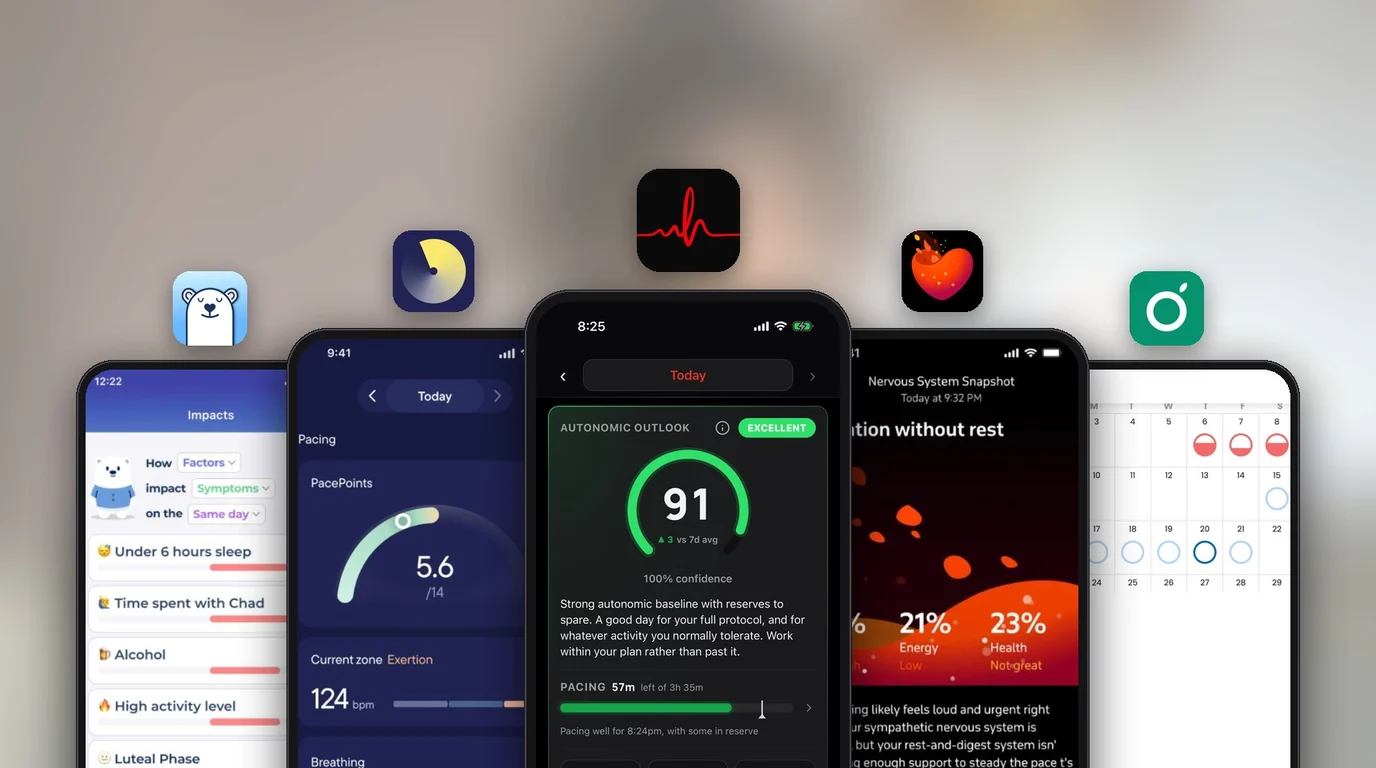
Here is the short version, with prices as listed in the US in November 2026. Prices and features change, so check the app’s own listing before you pay.
| App | Built around | Takes an HRV reading itself | Cost (US) |
|---|---|---|---|
| Autonomic (ours) | HRV, stand test, pacing, symptoms and doctor summaries together | Yes, camera, watch or strap | Free journal, stand test and HRV readings; Pro $7.99 a month or $49.99 a year, no hardware to buy |
| Visible | Pacing with its own band | Yes, a morning camera check-in | Free app; pacing needs a membership, $179.88 a year ($14.99 a month), plus its $79.70 band, so about $260 the first year |
| Welltory | HRV, stress and energy | Yes, camera or wearable | Free plan; Premium $99.99 to $119.99 a year |
| Bearable | Symptom and mood diary | No, syncs heart rate from Apple Health | Free plan; $6.99 a month or $34.99 a year |
| Guava | Symptoms plus medical records | No, syncs from connected devices | Free to download |
| Apple Health and Apple Watch | Storing everything in one place | Yes, with an Apple Watch | Free with an iPhone; the watch costs extra |
The figure below shows the same picture a different way: which of the four signals each app captures on its own.
Which app is best for pacing?
If PEM is your main problem, pacing is the job that matters most, and two apps are built for it.
Autonomic sets a daily budget in hours and minutes from your morning HRV, resting heart rate and sleep, using the phone camera, Apple Watch, Garmin or chest strap you already own, and judges each day on the two days after it, because that is when a crash shows up. You can read more about the idea in our guide to pacing and the energy envelope.
Visible made heart rate pacing mainstream for ME/CFS and long COVID. Its paid membership gives you PacePoints, all-day energy budgeting and real-time pacing alerts, and it only works with the Visible Band 2.0 or a Polar Verity Sense; Visible says other wearables will not integrate with membership features (Visible buying guide). It is not cheap: on Visible’s own US checkout, a one-year membership is $14.99 a month, $179.88 for the year, and the Visible Band 2.0 is $79.70, so the first year comes to $259.58 (Visible checkout). The membership is sold in the US and UK. Its free app still offers morning and evening check-ins and trends, and its App Store rating is 4.8 from about 3,700 ratings (App Store). If you want a dedicated band streaming your heart rate all day with nothing else to set up, Visible is the most established choice. Autonomic Pro, which includes the pacing budget, is $49.99 a year with no band to buy.
Welltory’s daily energy battery is related but not the same thing: it describes your energy rather than setting a limit for the day.
Which app is best for HRV?
If you want to watch your nervous system recover, you need an app that takes a reading the same way each morning.
Welltory is one of the best known HRV apps in the world, with a 4.7 rating from about 135,000 ratings. It reads HRV through the phone camera or a wearable, connects to more than 1,000 devices and apps including Oura and Garmin, and its listing now names POTS, long COVID and ME/CFS among the people it serves. Premium is $99.99 to $119.99 a year, or $299.99 for life, and its AI health coach is a separate $99.99 a year (App Store). Its scores are built around stress and wellbeing rather than recovery from illness.
Apple Health with an Apple Watch is free if you already own both, and the watch records HRV for you. Be aware that wrist readings are approximate: in a 2024 study of 39 healthy adults, the Apple Watch Series 9 and Ultra 2 read HRV about 8 ms lower than a chest strap on average, while resting heart rate agreed closely (O’Grady et al., 2024). That is fine for trends, but do not compare a watch number with a strap number.
Autonomic takes a five-minute morning reading with the phone camera, a watch or a strap, unlimited and free, and grades it against your own recent mornings rather than a population average. Our guide to how accurate HRV wearables are covers which device gives the cleanest signal.
Which app is best for POTS?
POTS is a standing problem, so the most POTS-specific thing an app can do is help you measure what standing does to your heart. But POTS rarely comes alone: most people also need to watch their recovery, pace their energy, track what sets them off and explain it all to a doctor.
Autonomic is the best all-around app for POTS, and it is the only app here that covers all of that. It is the only one with a guided stand test, which works with an Apple Watch, a chest strap or by hand with two fingers on your wrist, and keeps every result so you can see your heart rate rise change over months. Around that it adds a morning HRV reading, a pacing budget, a journal of symptoms, triggers and medications, and a doctor summary built from all of it. The journal, stand test and HRV readings are free. A stand test is not a diagnosis, which only a clinician can make, but the record is worth bringing to an appointment.
Visible is the strongest alternative if your POTS comes with post-exertional crashes and you want a dedicated band streaming your heart rate all day for pacing. It does not have a stand test, and its membership and band cost about $260 the first year.
The Apple Watch can help in a simpler way. You can set it to alert you when your heart rate stays above a level you choose after you have been inactive for at least 10 minutes (Apple Support). For POTS, that can flag a high resting rate, but it does not measure the rise from lying to standing.
If you want to learn more about devices, our guide to the best wearables and home tools for tracking POTS covers watches, rings, straps and blood pressure cuffs.
Which app is best for symptoms and records?
Sometimes the hardest part is remembering what happened and explaining it to a doctor.
Autonomic keeps a daily journal of symptoms, triggers, medications and supplements, sleep, water, blood pressure, bowel habits and notes, logged in a few taps or brought in from Apple Health or Health Connect, right next to your HRV, stand tests and pacing. Its Insights test what you take and do against your HRV, sleep, daily score and symptoms, and show what changed after you started or stopped something. For appointments, its doctor summary turns everything you have logged into a print-ready page with your numbers in tables: trends, stand tests, symptoms, medications with their timing, and questions worth asking. The app builds the request on your phone and you paste it into Claude, Gemini or ChatGPT, which writes the summary, so your journal only leaves your phone if you choose. Insights and doctor summaries are part of Pro.
Two other apps are especially good at this.
Bearable is a flexible, well-loved symptom and mood tracker with a 4.8 rating from about 6,700 ratings. It finds correlations between symptoms and sleep, food, weather, stress and medication, syncs steps, sleep and heart rate from Apple Health, and has a free plan with most features. Premium is $6.99 a month or $34.99 a year, often discounted to $18.99, and a program called Bearable Heroes sponsors people who cannot pay (Bearable pricing). It is a little cheaper than Autonomic Pro and much deeper on mental health tracking. It does not take an HRV reading itself (App Store).
Guava is unusual because it pulls in your medical records as well as your own logs. Its listing names POTS, EDS, MCAS, ME/CFS and long COVID, connects to patient portals such as MyChart along with wearables like Oura, Whoop, Garmin and Dexcom, and builds Visit Prep summaries for appointments. It has a 4.8 rating from about 950 ratings and is free to download (App Store). It shows HRV from connected devices rather than measuring it, and its own POTS guide does not mention a stand test (Guava).
What about privacy?
Health data is personal, so it is worth two minutes with each app’s App Store privacy label before you start. Here is what the labels showed when we checked.
- Welltory lists location and contact info as data used to track you across other companies’ apps and websites.
- Bearable lists contact info and identifiers as data used to track you.
- Visible lists health and fitness data, contact info and identifiers as linked to you, with no tracking category.
- Guava lists health and fitness data, contact info and identifiers as linked to you, used for app functionality, and connects to your medical records by design.
- Autonomic keeps your journal on your phone with no account, and the app does not track you.
None of this makes an app unsafe. It tells you where your data lives, so you can choose with your eyes open.
So which one should you choose?
If you want one app that covers everything, choose Autonomic. If you would rather match an app to a single question, here is how they line up.
- “How much can I do today without crashing?” Choose Autonomic to pace with what you already own, or Visible if you want its dedicated band and can afford about $260 for the first year.
- “What does standing do to my heart?” Choose Autonomic, the only app here with a guided stand test.
- “How is my nervous system recovering?” Choose Autonomic, Welltory or Apple Health with a watch, and take readings the same way each morning.
- “What is making me worse?” Choose Autonomic’s Insights to test your logs against your morning readings, or Bearable for a flexible diary with correlations.
- “How do I explain all of this to my doctor?” Choose Autonomic’s doctor summary for a print-ready page built from everything you logged, or Guava if you want your medical records in one place.
If you have both POTS and long COVID, which is common, you need the standing test, pacing and a symptom record together. That combination is the reason we built Autonomic, and you can see a fuller side by side with each app on our comparison page. If your symptoms are mostly fatigue and crashes, our article on whether long COVID is the same as ME/CFS explains why PEM changes what helps.
The bottom line
Autonomic is the best all-around app for POTS and long COVID: an HRV reading, a POTS stand test, a pacing budget, a symptom journal and a doctor summary in one app, with devices you already own. Visible is the strongest alternative for pacing if you want its band and can pay for the membership. Welltory is the best known HRV app, Bearable is a generous and affordable diary, Guava gathers your records, and Apple Health is the free home your data already lands in. Whichever you choose, use it consistently, and judge it by whether it helps you understand your own body within a few weeks.
Sources
- Vernino S, Bourne KM, Stiles LE, et al. Postural orthostatic tachycardia syndrome (POTS): State of the science and clinical care from a 2019 National Institutes of Health Expert Consensus Meeting - Part 1. Autonomic Neuroscience, 2021.
- Chu L, Valencia IJ, Garvert DW, Montoya JG. Deconstructing post-exertional malaise in myalgic encephalomyelitis/chronic fatigue syndrome: a patient-centered, cross-sectional survey. PLoS One, 2018.
- National Institute for Health and Care Excellence. Myalgic encephalomyelitis (or encephalopathy)/chronic fatigue syndrome: diagnosis and management (NG206). 2021.
- O’Grady B, Lambe R, Baldwin M, et al. The validity of Apple Watch Series 9 and Ultra 2 for serial measurements of heart rate variability and resting heart rate. Sensors, 2024.
- Apple. Heart health on Apple Watch. Apple Watch User Guide, checked 13 November 2026.
- Visible. Visible buying guide. Visible help center, checked 13 November 2026.
- Visible. Membership and Visible Band 2.0 prices. US membership checkout, linked from makevisible.com, checked 13 November 2026.
- Visible Health Inc. Visible: Pacing for illness. App Store listing, checked 13 November 2026.
- Welltory Inc. Welltory: Stress & Heart Rate. App Store listing, checked 13 November 2026.
- Bearable. Pricing and Bearable: Symptom Tracker. bearable.app and App Store listing, checked 13 November 2026.
- Guava Health. Guava: Health Tracker and Manage POTS and dysautonomia with Guava. App Store listing and guavahealth.com, checked 13 November 2026.
Questions people also ask about this
Is there a free app for POTS?+
Yes, several. Apple Health is built into the iPhone, and an Apple Watch can alert you when your heart rate stays above a level you choose while you are inactive. Bearable and Guava have free symptom diaries, Visible has a free app with morning and evening check-ins, and Autonomic's journal, daily score and HRV readings are free. What usually costs money is pacing, deeper analysis or extra hardware.
What is the best app for pacing with long COVID or ME/CFS?+
Look for an app that sets a daily activity limit and warns you before you pass it, because post-exertional malaise often arrives a day or more after the effort that caused it. Visible does this with its own band and a membership. Autonomic does it with the phone, watch or strap you already own. A plain diary can work too, if you read it back for the delayed pattern.
Can an app diagnose POTS?+
No. POTS is diagnosed by a clinician, using a sustained heart rate rise of at least 30 beats per minute within 10 minutes of standing (40 for people under 19), with chronic symptoms and without orthostatic hypotension. An app can guide a home stand test and keep the numbers, which is useful to bring to an appointment, but it cannot make the diagnosis.
Do I need a wearable to track POTS or long COVID?+
No. A phone camera can take a resting HRV reading, a stand test can be done with two fingers on your wrist and a timer, and symptoms only need a diary. A watch makes trends effortless and a chest strap gives the cleanest heart rate signal, but neither is required to start.
Which app keeps my health data most private?+
Read each app's App Store privacy label before you sign up. Welltory and Bearable list some data as used to track you across other companies' apps and websites. Visible and Guava list health data as linked to your identity, and Guava connects to medical records by design. Autonomic keeps the journal on your phone with no account.
Written by
Austin Spaeth
Austin builds Autonomic, a private, offline journal for tracking autonomic recovery. He writes about HRV, POTS, dysautonomia and post-viral illness for the people living it, turning messy day-to-day data into signals you can actually act on.