




Social posts for this article
Not provided.
The short answer
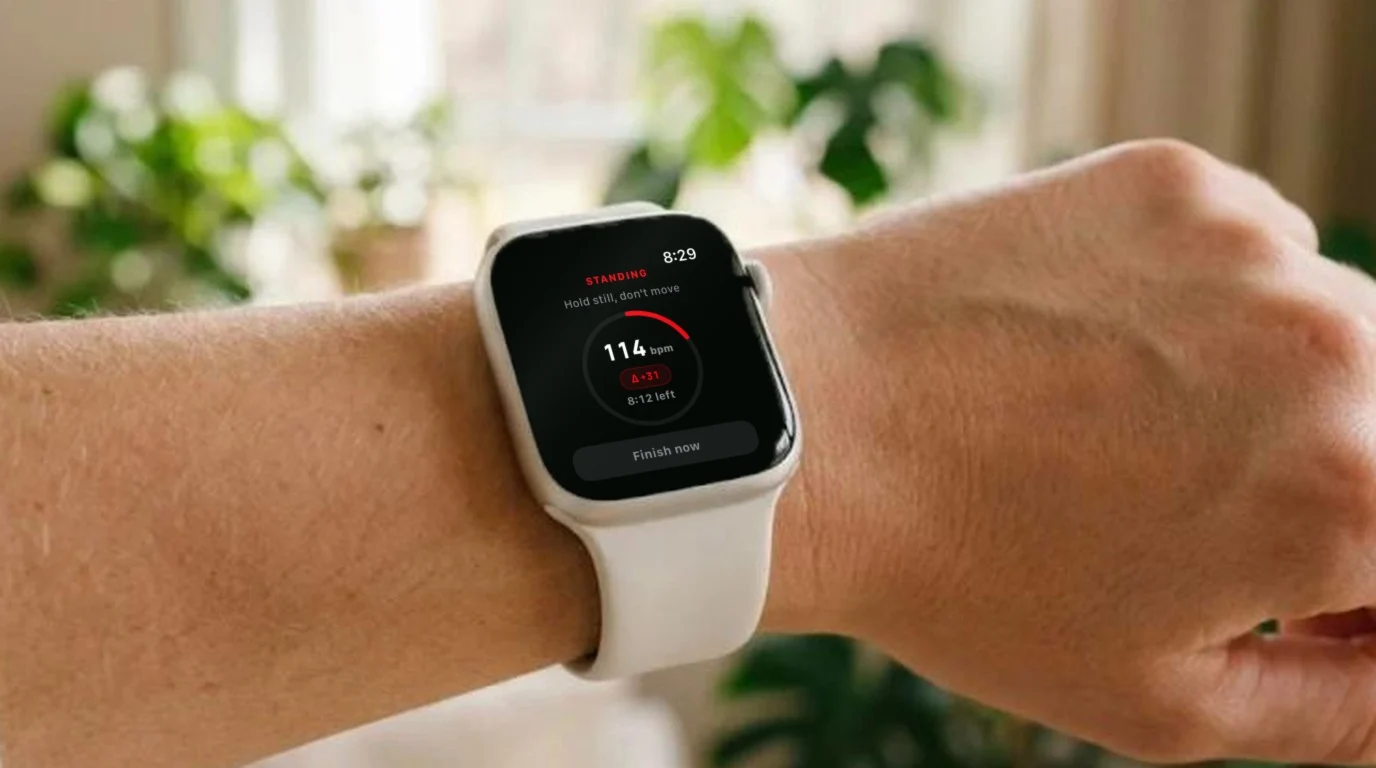
No.An Apple Watch cannot diagnose POTS, and none of its built-in alerts are designed to look for it. A diagnosis needs a sustained heart rate rise of at least 30 beats per minute within 10 minutes of standing (40 for ages 12 to 19), no big drop in blood pressure, months of symptoms and other causes ruled out, and the watch can only measure the first of those. It does measure heart rate well enough at rest to run a home stand test: lie down for five minutes, stand still for ten, and note your heart rate at each minute. A repeated rise of 30 or more is worth taking to a doctor, along with your readings.
Maybe your watch buzzed with a high heart rate warning while you were standing at the kitchen counter. Maybe you noticed your heart rate jumps every time you get up. Either way, it is natural to wonder whether the device on your wrist can tell you if you have POTS. It can’t diagnose POTS, but it can measure the heart rate rise on standing that sits at the center of the diagnosis. Used the right way, that measurement is worth taking to a doctor.
What does a POTS diagnosis actually need?
Postural orthostatic tachycardia syndrome is defined by what happens when you stand, plus a few things that have to be ruled out. The consensus criteria, set out by the Heart Rhythm Society and summarized in a 2023 Cleveland Clinic review, are (Sheldon et al., 2015; Aboseif et al., 2023):
- A sustained heart rate rise of at least 30 beats per minute within 10 minutes of standing or tilting, or at least 40 for people aged 12 to 19.
- No orthostatic hypotension, meaning blood pressure does not fall by 20 points systolic or 10 diastolic or more on standing.
- Symptoms for at least three months, such as lightheadedness, palpitations, shakiness or brain fog when upright, that improve when you lie down.
- No other explanation, such as dehydration, anemia, an overactive thyroid, medication effects or prolonged bed rest.
Only the first of those is a heart rate measurement. The second needs blood pressure readings while you stand, and the last two need a clinician who knows your history. That is why no wearable on the market can give you a POTS diagnosis on its own.
What can an Apple Watch measure, and what can’t it?
The watch is good at one piece of this and blind to the rest.
| Apple Watch | What a diagnosis needs | |
|---|---|---|
| Heart rate lying and standing | Yes, if it is measuring continuously | Yes, at rest and over 10 minutes upright |
| Blood pressure on standing | No | Yes, to rule out orthostatic hypotension |
| Your symptoms | No, unless you log them | Yes, for at least three months |
| Other causes | No | Yes, usually with blood tests and a history |
| A POTS alert | None exists | Not applicable |
Newer Apple Watch models can send hypertension notifications, but they look for signs of high blood pressure over 30-day periods and do not give you a reading (Apple). They cannot show a drop in blood pressure when you stand, so they cannot rule out orthostatic hypotension. If your doctor wants standing blood pressure, you need an upper-arm cuff, ideally with someone to help you take readings while you stand.
The irregular rhythm notification looks for atrial fibrillation, which is a different problem. In POTS the rhythm is usually normal; it is simply fast.
How accurate is the Apple Watch when you stand up?
Accurate enough for a stand test, if you keep still. In a well-known Cleveland Clinic study, researchers compared several wrist trackers and a chest strap against an ECG. The chest strap was the closest match, the Apple Watch was the most accurate of the wrist devices, and every wrist device became less accurate as exercise got harder (Wang et al., 2017).
A stand test is close to the best case for a wrist sensor: you are not swinging your arms or sweating, and the readings that matter come while you are standing still. A few things still help:
- Wear the band snug, a finger’s width above the wrist bone, so the sensor stays in contact.
- Keep your arm relaxed at your side and do not fidget or talk while standing.
- Ignore the first few seconds after you stand. Everyone’s heart rate spikes briefly on standing. POTS is about the rise that lasts.
- Use a chest strap if you can. It reads the heart’s electrical signal, like a clinic ECG, and is the better choice if your watch readings jump around. We compare options in our guide to how accurate HRV wearables are.
How do you run a stand test with your Apple Watch?
The at-home version of the clinic’s active stand test takes about 15 minutes. Do it in the morning before caffeine, ideally on two or three different days.
- Start continuous heart rate. Open the Heart Rate app on the watch and keep it on screen, or start an Other workout, so the watch measures continuously rather than every few minutes.
- Lie down for five minutes. Stay still and relaxed. Note your heart rate at the end; that is your baseline.
- Stand up and stay standing for ten minutes. Stand still, without leaning on a wall or shifting your weight much. Have someone nearby, and sit or lie down at once if you feel faint.
- Note your heart rate at 1, 3, 5 and 10 minutes, or every minute if you can, along with any symptoms.
- Work out the rise. Subtract your lying baseline from your standing readings. A rise of 30 or more (40 or more for ages 12 to 19) that holds through the later minutes is the pattern linked to POTS.
Our full guide to the orthostatic stand test at home covers the protocol in more depth, including what your recovery after lying back down can show.
What do Apple Watch high heart rate alerts mean for POTS?
The high heart rate notification fires when your heart rate stays above a threshold you choose while you seem to have been inactive for at least 10 minutes (Apple). It was designed to catch a fast heart rate at rest, but it cannot tell whether you are lying on the sofa or standing still.
That matters with POTS. Standing in a queue, cooking, showering or waiting at a bus stop all count as inactive to the watch, yet they are exactly when an upright heart rate climbs. So many people with POTS get frequent alerts, and for some, those alerts are what first prompt them to see a doctor.
The alerts are worth noting, especially if they cluster around standing, but they are not a test. They do not record your lying heart rate, so they cannot show the rise, and plenty of other things raise heart rate too. If alerts are a daily occurrence, write down what you were doing each time and bring that list along with your stand test results.
Can the watch help after a diagnosis?
Yes, and this is where it is most useful. Once you know you have POTS, the same stand test repeated every few weeks shows whether treatment is helping: more fluids and salt, compression, medication or a reconditioning program should, over time, shrink the rise. Our guide to how to lower a high heart rate with POTS covers those options.
The watch’s other data can help too. Resting heart rate and heart rate variability trends often shift with POTS flares, illness and poor sleep, though Apple’s HRV number needs careful reading; we explain why in Apple Watch HRV with POTS or long COVID.
When should you see a doctor?
See a doctor if your stand tests show a repeated rise of 30 or more, or if you have months of lightheadedness, palpitations or fatigue when upright, whatever the watch says. Bring your readings and symptom notes, and ask whether a clinic active stand test with blood pressure or a tilt table test makes sense. Normal readings on the watch do not rule POTS out if your symptoms fit, because heart rate on standing varies from day to day.
The bottom line
An Apple Watch cannot detect or diagnose POTS, and its alerts are not built to look for it. What it can do is measure how much your heart rate rises when you stand, which is the one part of the diagnosis you can check at home. Run a proper stand test on a few mornings, keep the numbers, and take them to a clinician who can check your blood pressure and rule out other causes.
Sources
- Sheldon RS, Grubb BP, Olshansky B, et al. 2015 Heart Rhythm Society expert consensus statement on the diagnosis and treatment of postural tachycardia syndrome, inappropriate sinus tachycardia, and vasovagal syncope. Heart Rhythm, 2015.
- Aboseif A, Bireley JD, Li Y, Polston D, Abbatemarco JR. Autoimmunity and postural orthostatic tachycardia syndrome: implications in diagnosis and management. Cleveland Clinic Journal of Medicine, 2023.
- Vernino S, Bourne KM, Stiles LE, et al. Postural orthostatic tachycardia syndrome (POTS): state of the science and clinical care from a 2019 National Institutes of Health expert consensus meeting, part 1. Autonomic Neuroscience, 2021.
- Wang R, Blackburn G, Desai M, et al. Accuracy of wrist-worn heart rate monitors. JAMA Cardiology, 2017.
- Apple. Hypertension notifications on Apple Watch.
- Apple. Monitor your heart health on Apple Watch.
Questions people also ask about this
Can an Apple Watch diagnose POTS?+
No. POTS is diagnosed by a clinician, usually with an active stand test or a tilt table test, and the criteria include more than heart rate: no significant drop in blood pressure, symptoms for at least three months and other causes of a fast heart rate ruled out. An Apple Watch cannot measure blood pressure on standing and has no feature that screens for POTS. It can measure the heart rate part of the picture.
Can an Apple Watch tell if my heart rate goes up when I stand?+
Yes, if you set it up for it. Keep the Heart Rate app open on the watch, or start a workout, so it measures continuously, then lie down for five minutes and stand still for ten. Wrist readings are most accurate when you are still, which suits a stand test. A rise of 30 beats per minute or more that lasts while you stand, not just a brief spike, is the pattern linked to POTS.
Why does my Apple Watch keep saying my heart rate is high?+
The high heart rate notification fires when your heart rate stays above a threshold you choose while you appear to have been inactive for at least 10 minutes. With POTS, standing still in a queue, showering or cooking can push your heart rate high while the watch counts you as inactive, so frequent alerts are common. They are worth mentioning to a doctor, but they do not say why your heart rate was high.
Is an Apple Watch accurate enough for a POTS stand test?+
It is reasonably accurate at rest, which is when a stand test takes its readings. In a Cleveland Clinic study against an ECG, a chest strap was the most accurate device and the Apple Watch was the most accurate of the wrist trackers, with accuracy falling as exercise got harder. Keep your arm still and the band snug, and use a chest strap if you want the closest match to a clinic ECG.
What should I do if my watch shows a big rise when I stand?+
Repeat the test on two or three different mornings, write down your lying and standing heart rates and any symptoms, and take the results to your doctor. Ask whether an active stand test with blood pressure or a tilt table test makes sense. Seek urgent care for fainting with injury, chest pain or severe shortness of breath.
Written by
Austin Spaeth
Austin builds Autonomic, a private, offline journal for tracking autonomic recovery. He writes about HRV, POTS, dysautonomia and post-viral illness for the people living it, turning messy day-to-day data into signals you can actually act on.


